

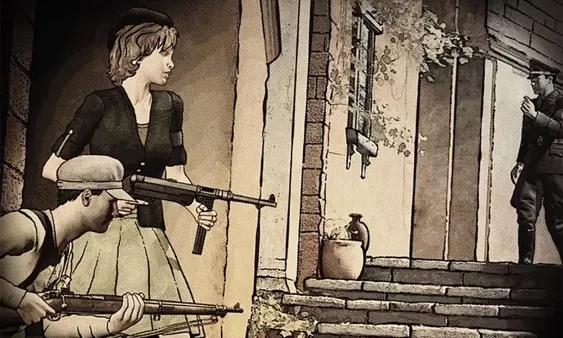
In the Shadows is a lunchtime game from GMT. It is a small footprint game that can be played in 45 minutes. It is a 2 player game set in occupied France during World War II. One player plays the Resistance, composed of the French and their allies responsible for destabilizing the occupying Germans by lowering their Authority; and the other player plays the German Occupation forces, responsible for sending plundered resources back to Germany and preventing the Resistance from causing too much chaos. The game also comes with a solo variant.
What’s in the box
The box comes in a bookcase-style box and contains 1 map board, 2 rulebooks (2-player and solo), a deck of Event Cards, Resolution Cards, plastic Action pawns, wooden cylinders and cubes, 2 player aids, and punch board markers.
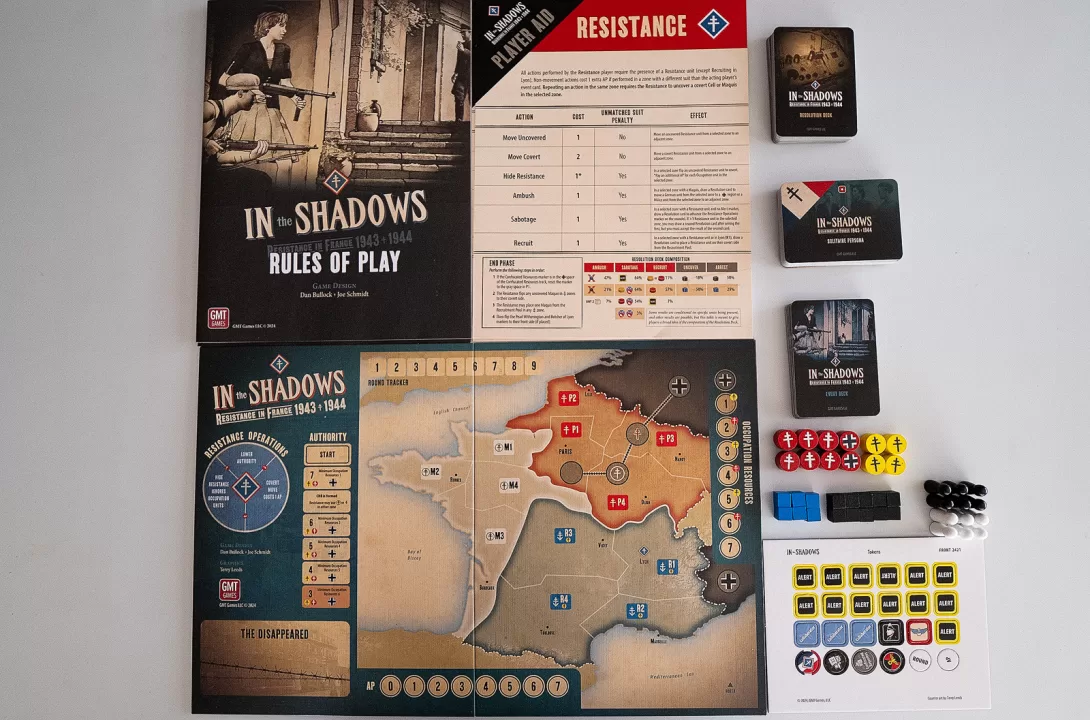
What you get with In the Shadows
Shadow warfare in World War II
The Occupation player is represented in the game by German (Gestapo) units (black cubes) and French Milice (blue cubes). The Resistance is represented by Resistance Cells (red cylinders) and Maquis units (yellow cylinders). These Resistance units are either covered (facedown) or uncovered (face up). They start the game covered. Two of these red cylinders are actually Informants, and when flipped to their uncovered side, they become part of the Occupation units.
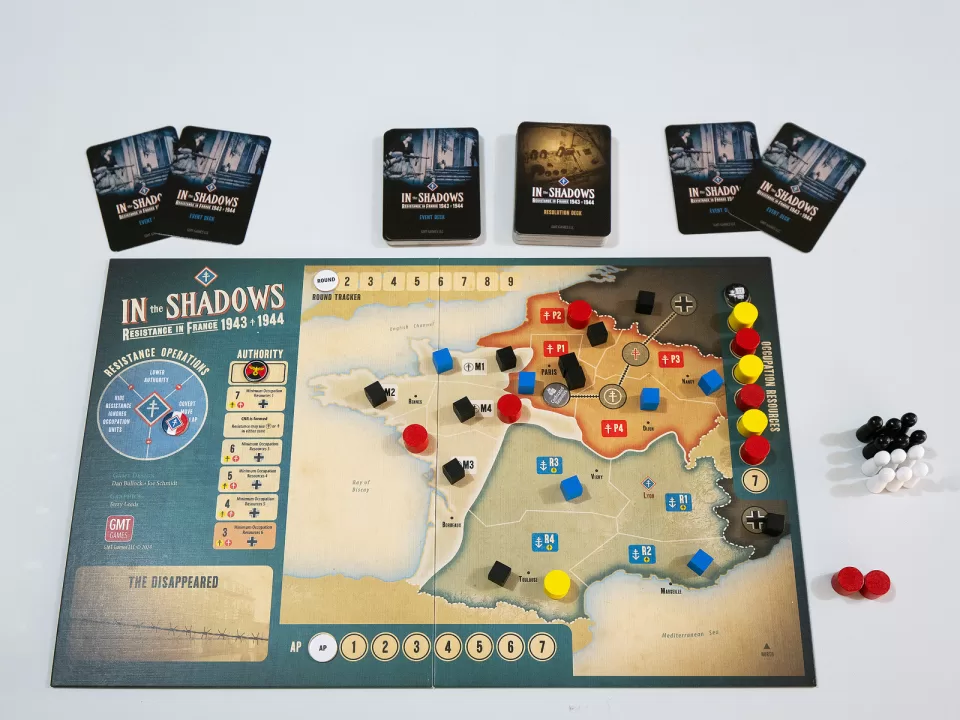
Game at setup and ready to play
The game lasts 9 rounds, and each round is driven by Event Cards. Each player plays an Event Card from his hand. Much like many card-driven games, the Event Card has printed events that favor one side and a number of Action Points that the active player may use to execute Actions.
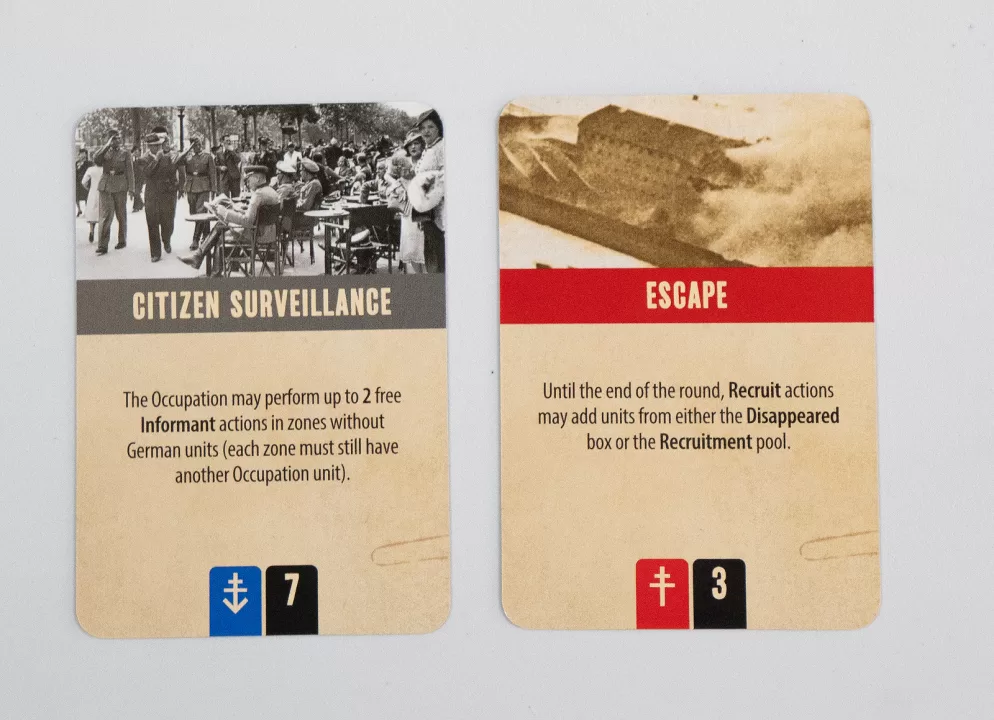
Event Cards have faction-specific Events, a Suit, and Action Points.
At the beginning of a round, each player will have 2 Event Cards in hand and will choose one of those cards to play in secret. The player who played the card with the higher action points chooses who goes first, and that player becomes the Active Player.
The event on the acting player’s Event Card is resolved – red events are resolved by the Resistance player and grey events are resolved by the Occupation player. Once events are resolved, the Acting Player performs Actions with the number of Action Points printed on the Event Card.
Each Event Card also has a Suit that matches a District on the Map. Actions performed outside of the Suit’s District cost more in terms of Action Points.
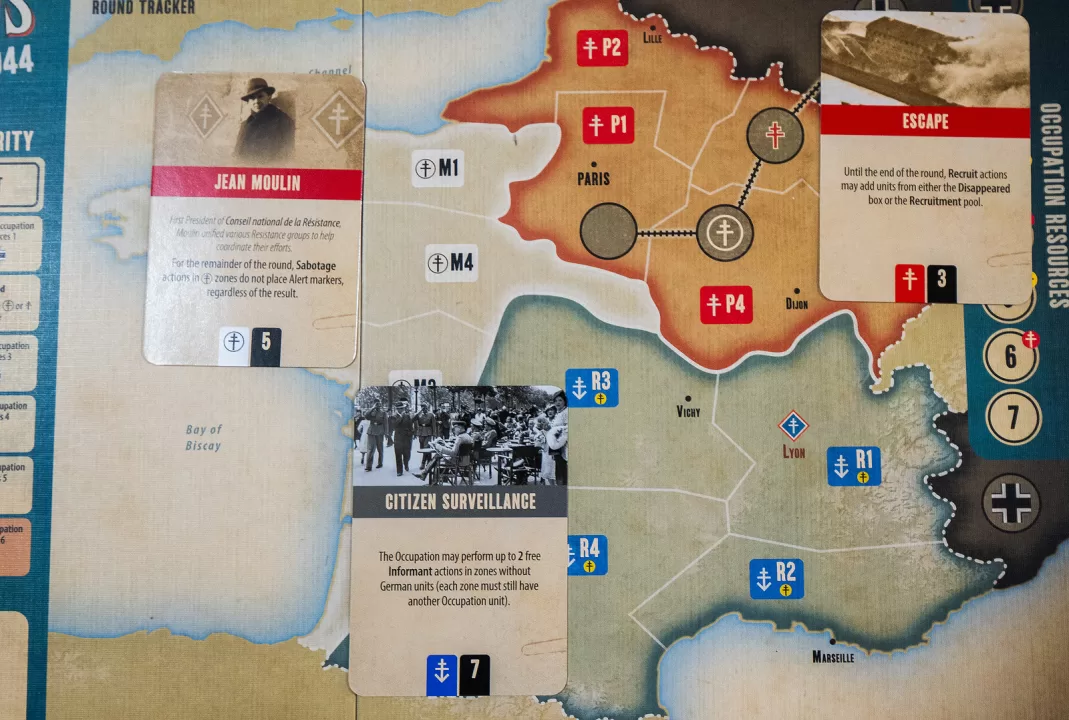
Event Card suits match Districts and Zones in the Map.
The Actions of the Occupation player revolve around Move-ing his units, Uncover-ing covered Resistance units, Arrest-ing uncovered Resistance units, and the Round Up of Confiscated Resources to send back to Germany. His main aim is to Arrest as many Cells and Maquis as he can, but he can only Arrest a unit he has already Uncovered. Certain Actions, like Uncover and Arrest, require a Resolution Card to determine whether it was successful.
Resistance Actions are Move (it costs more to move a covered cylinder), Hide an uncovered cylinder, Ambush Occupation units which moves the target enemy unit to a different Zone, Recruit to add more Resistance units to the board, and Sabotage. Certain actions require a Resolution Card draw to determine if it succeeds. A successful Sabotage attempt moves the Resistance Operations Marker around a rondel and every time the marker reaches the Lower Authority Space, the marker in the German Authority Track is lowered. This Track contains the winning conditions for the Occupation side and lowering this Track makes it more difficult for the Occupation player to win.
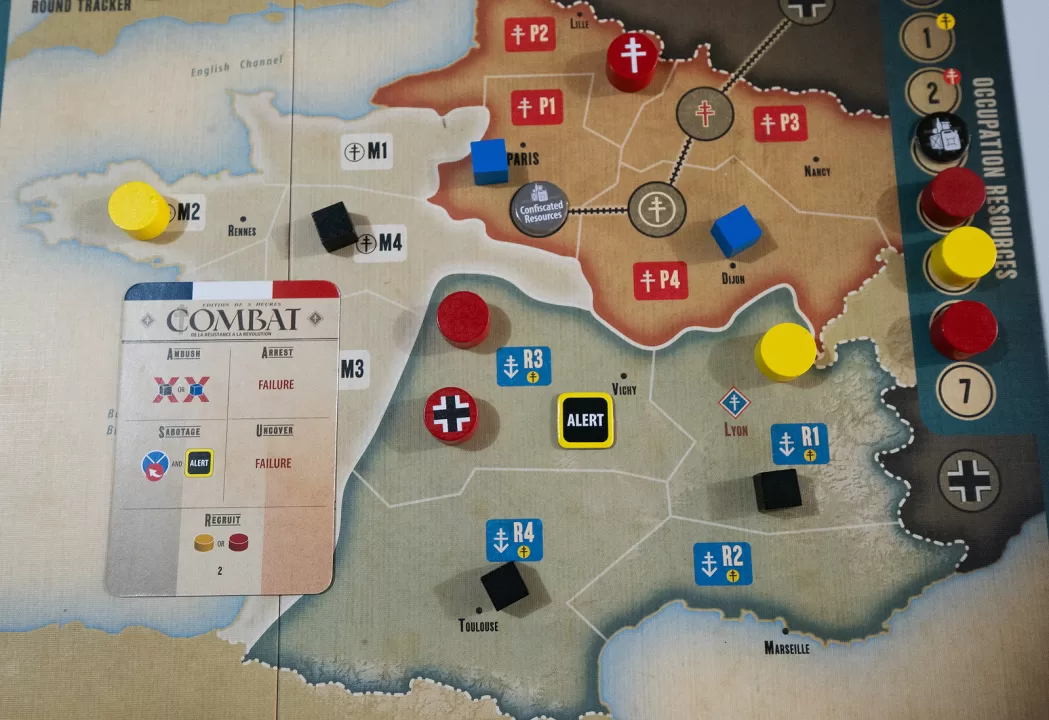
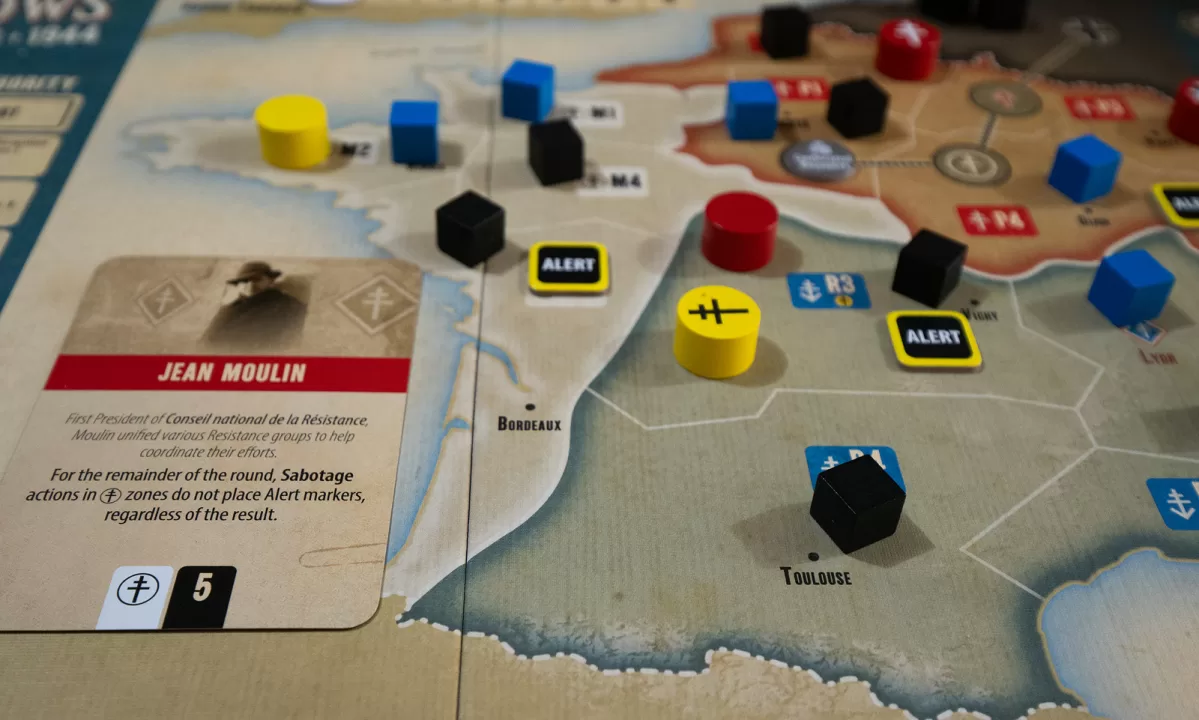
The Resistance attempts a Sabotage Action in R3. He draws a Resolution Card and succeeds! But an Alert marker is placed.
The Occupation player wins if he has eliminated all Resistance pieces on the map and met the minimum required Confiscated Resources on the Authority track. Or if it has Confiscated the maximum number of Resources and the Resistance player as fewer than the required units on the map. If play continues to the end of Round 9, the Occupation player wins if they have fulfilled the requirements on the Authority Track; otherwise, the Resistance wins.
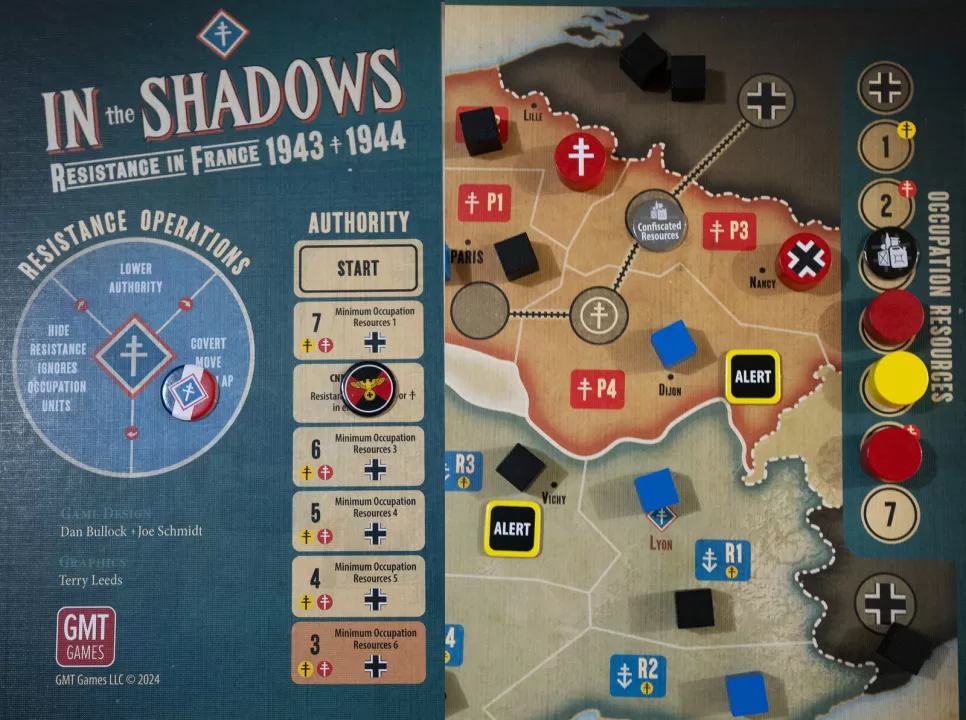
The Authority Track on the left and the Occupation Resources Track on the right, are important for winning the game.
That is a very streamlined description of game mechanics but for a more in-depth look a gameplay, check out this video.
COIN for the Masses
In the Shadows is a game where one side plays an imposing military and police presence against a weaker opponent who uses subterfuge to win. The Resistance has no way to eliminate Occupation units; they can only move these units to different Zones, and for most of the game, the Resistance is better served avoiding these enemy units when possible. On the contrary, Occupation units can eliminate uncovered Cell or Maquis. Thus, remaining hidden and covered is paramount to Resistance units. As such, it plays very much like a simplified COIN game. COIN stands for Counter Insurgency game system. It is one of the most popular series of games from the publisher GMT. Just like In the Shadows, COIN games are card-driven games, where you have an Event Card setting up play for the Round. Also like In the Shadows, COIN games have a weaker, clandestine insurgent side pitted against a militarily and administratively superior side. Where In the Shadows differs is its ease of play and relatively short play time, making the game a great introduction to COIN-like mechanics, accessible to casual gamers or even non-gamers.
The game design of In the Shadows is impressive as it manages to fit strategic gameplay in a very compact ruleset and short playing time. Although the game is asymmetric, each side only has a limited number of Actions, and each Action is easy to understand and execute. The boardgame map is equally compact, making it difficult for the Resistance player to evade Occupation forces. The Authority Track and Resource Track, the 2 main objective drivers in the game, are both easy to understand.
The game system is very evocative of the theme. There are only 9 rounds in the game, and both sides feel pressure trying to accomplish their objectives. Resistance units feel extremely vulnerable when uncovered. Sabotage becomes a strategic exercise of pushing the Resistance’s luck – it can lower the German Authority Track but potentially uncover Resistance pieces and raise Alert levels. Its use should therefore be timed properly, executed in the right zones by the best-positioned units. The Occupation player feels the pressure of sending Resources to Germany while trying to Arrest enemy units and keeping Resistance chaos to a minimum. He will likely not have time to do both, so he must weigh his Actions accordingly.
Event Cards bring the important history of occupied France to the game and are a big part of the thematic enjoyment of the game. However, the game’s theme could also be a disadvantage. If one is not interested in Occupied France during World War II, the game could just fly over the heads of players despite its accessible design.
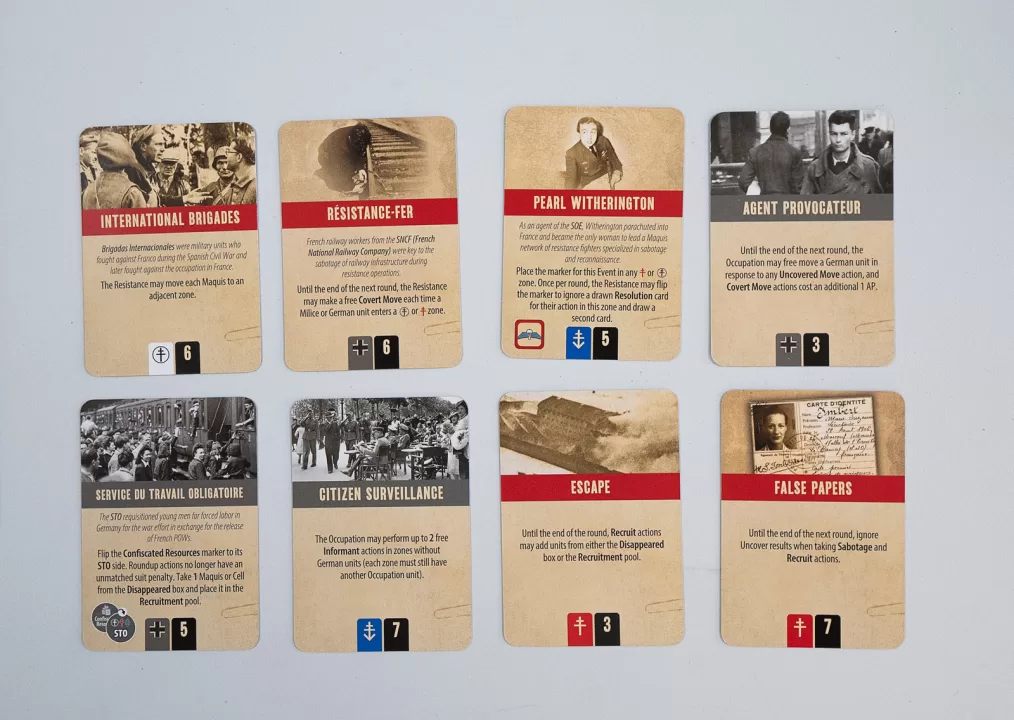
Snapshots of history in the Event Cards
However, I wish the game had more Event Cards. You basically see the whole Event deck in a game. I’m sure this was done to balance the game, but I think, it would have been better to have more Events to add flavor and more replayability to the game.
The game also comes with a Solo Mode, where the player plays the Resistance, and the game bot plays the Occupying Germans. It comes with its own rulebook and cards. The solo game was fine, but nowhere near as good as the 2-player game.
Fast, easy play with good depth
Lunchtime games like In the Shadows are meant to be played often. Despite the truly elegant design, I’m not sure how good the game will hold up to replayability. I played the game four times in 2-player and twice in Solo Mode. Although most games) played differently, I couldn’t get over the fact that I was seeing the same Event Cards game after game. I really think this was a missed opportunity. That being said, I still think In the Shadows is a worthy addition to your collection. It serves as a historical reflection, a gateway to the COIN system, and a good, fast-playing asymmetric 2-player game that can be played by casual and non-gamers alike.