

The Sengoku Jidai period of 16th-century Japan has always been a popular topic, especially with the remake of the Shogun limited series. Designers David Tompson and Trevor Benjamin take their General Orders series from World War II to the warring states of feudal Japan. Is the new game a reskin of the original game, or does it have something more to offer? Let’s find out..
What’s in the Box
The game comes in a travel-sized box. Inside you’ll find a double-sided map and support board; wooden Commander, Troop, Ship, and Siege Engine pieces; 2 decks of 24 cards to be used with the different sides of the map; 4 custom dice; a board containing bonus tokens and the round marker; and a rulebook and 2 player aids.
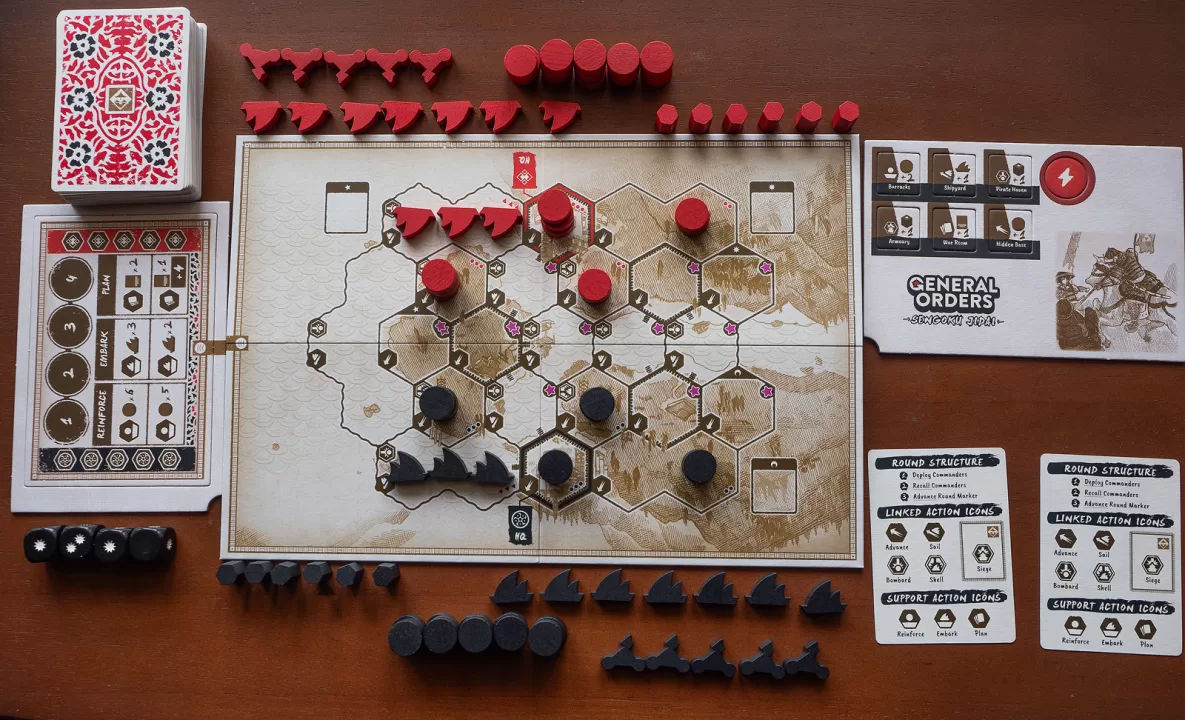
Game components and setup for “Rivers” map
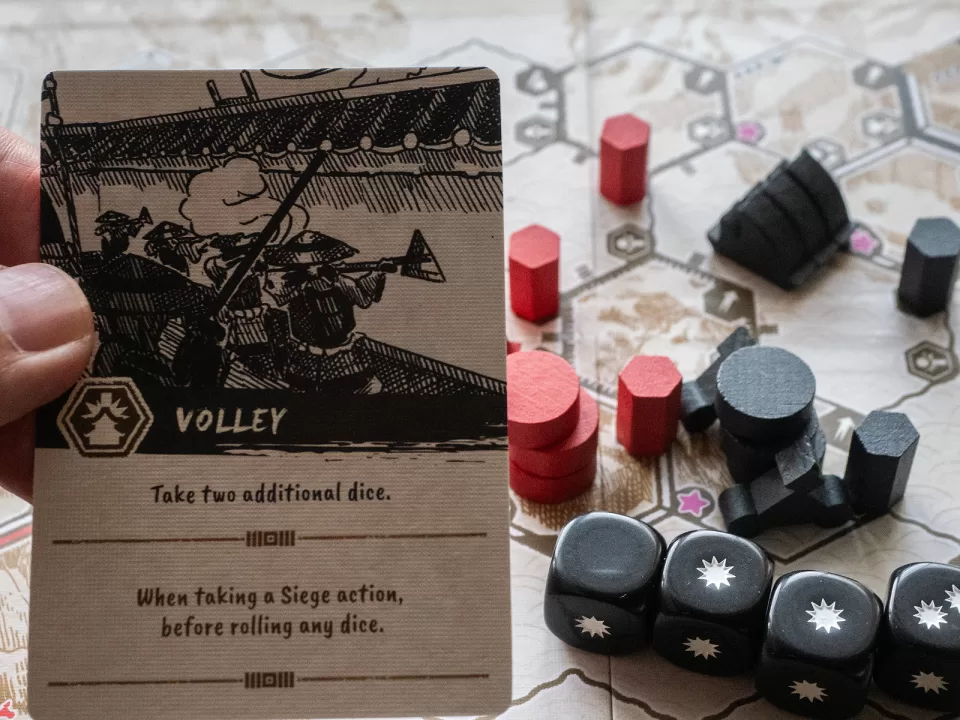
The art style of Tanner Staheli is excellent. His clean rendition of the maps with muted earthen tones feels like a landscape painting from 16th-century Japan. The markings on the map and support board are clear and also add to the artistry. The cards are designed around this muted earthen tone and have nicely illustrated battle scenes that depict the cards’ use. The text on the cards is easy to read and interpret as well. The wooden pieces fit well into areas of the map board, but they can look slightly overcrowded when players stack multiple pieces. Their aesthetic, however, complements the overall look of the game. The custom black 6-sided dice have one side with no hits, a side with 2 hits, and 4 sides with 1 hit. They have rounded corners and are of good heft and quality.
Overall, the game looks sharp with high-quality components that fit into a very portable form factor.
Samurai Showdown
Sengoku Jidai, like its predecessor, General Orders: World War II, is a 2-player worker placement wargame published by Osprey Games. The game space consists of a map and a support board. Players choose which map side they want to play and flip the support board into the appropriate side for the map. The map contains icons for the starting setup of each player. The round marker is flipped to determine the first player. Each player then takes turns placing their cylindrical Commanders on worker placement spots in the map or support board. The spots on the map allow pieces to move and attack each other. The spaces on the support board allow players to recruit units, draw operation cards, or flip initiative for the next round. Areas on the map are either river or land tiles. Only Ships can move through river tiles (via the “Sail” action), and only Troops and Siege Engines can move through land tiles (via “Advance”). But land units can use Ships as a sort of bridge to cross rivers and get to other islands on the map. The game simulates supply such that all units must be able to trace back a line of controlled tiles to the player’s HQ, or it cannot be ordered by a commander.
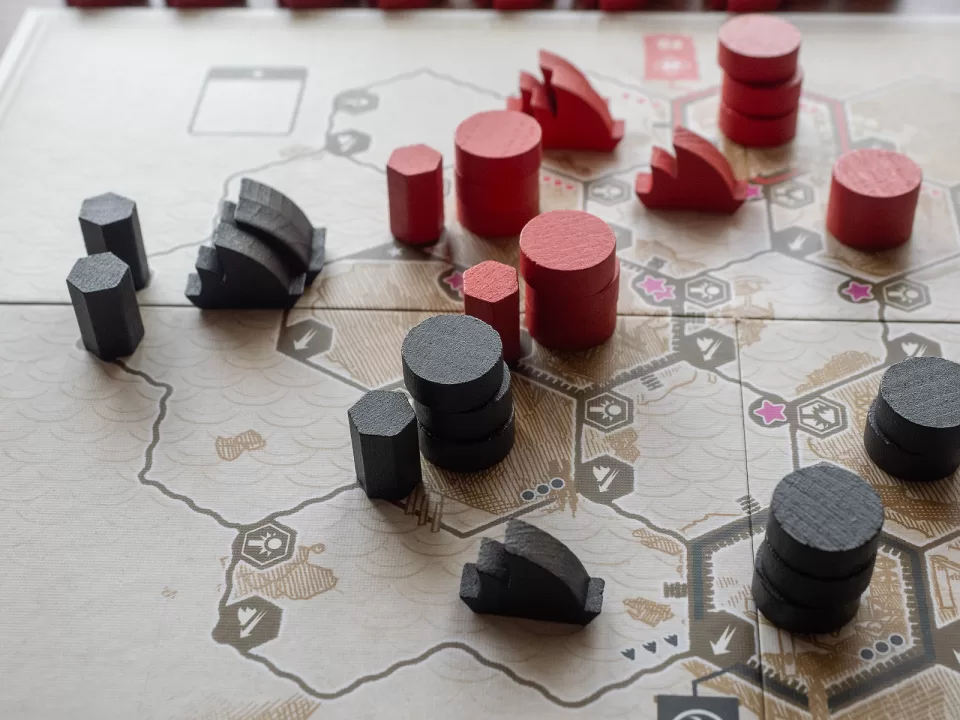
A game in progress
Units attack each other via long-range attacks such as “Bombard” and “Siege,” which use dice to determine the number of “hits”. A Conflict occurs when one player’s units enter a tile containing units of the other player. In this case, the defending player rolls a die and subtracts that amount of units from the attacking player. Then each player simultaneously removes units until one player has no more units remaining (“Attrition”). Once players have placed all their Commanders, the round ends. They each retrieve their Commanders, the round track is advanced, and a new round begins.
Some game tiles contain bonus tokens and victory points. Play continues till one of the HQ’s destroyed or 4 rounds have elapsed, wherein the player with the most number of victory points wins.
The Euro Art of War
The game deftly combines the eurogame style of worker placement and card play with the tactical play and direct conflict of a wargame. Although the game is definitely more wargame, I like seeing this kind of hybrid design in my games, and I feel such designs enrich the gaming experience as a whole.
Senjuku Jidai is easy to learn. The rulebook is clear with many examples, and gameplay is smooth. That being said, every game I played has been tight, with each placement of a commander an excruciating decision that could turn the tide of battle. You will definitely want those powerful Operational Cards, but how many Commanders do you commit to getting them? You want to prepare for an attack, but you know you need to shore up your defenses for the inevitable attack this round lest your troops be left out of supply. You want to reinforce your attacking Troops, but you know your opponent’s ships are in position to bombard them once they set foot. The choices are tense, agonizing, and exciting.
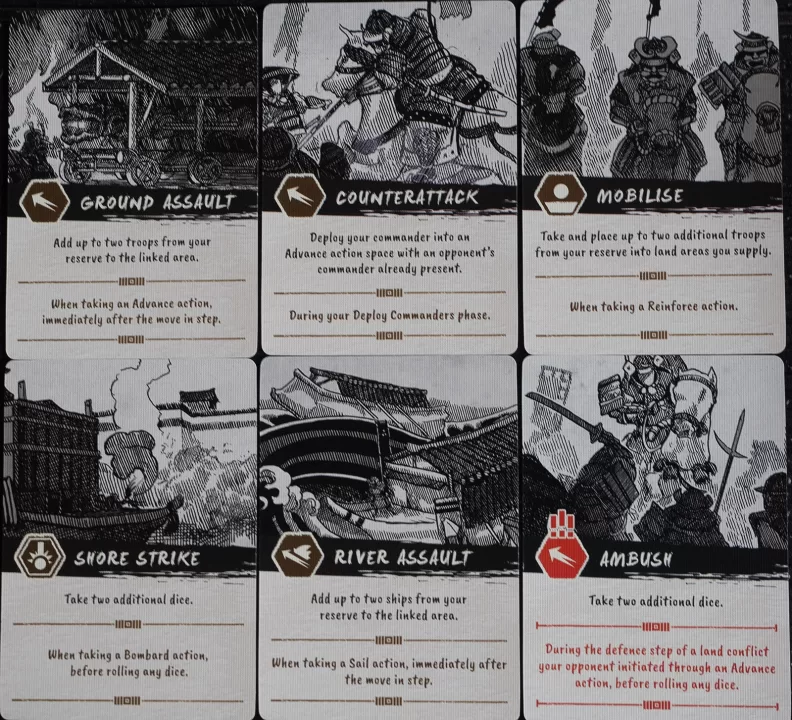
Operation Cards are powerful but situational.
The addition of ships, together with the map layouts, makes this iteration a much more dynamic experience compared to the original. There are more “routes” to attack, and it’s more possible to execute flank maneuvers, and amphibious landings are always a potential danger. The first map, “Rivers,” is symmetrical and emphasizes the importance of ships with many land tiles separated by rivers. The second map, “Fortress,” is asymmetric, and it feels like a bigger, more open map compared to the first. As the name implies, the second map features fortresses that have 2 defensive dice instead of the usual 1 dice, making them difficult to attack. The Siege Engine unit makes its appearance here to help break through fortresses, and with Operational Cards that add to its usefulness.
Final Verdict – 9/10
It’s no easy feat designing a game that incorporates euro and wargame sensibilities; that comes in a portable form factor; that contains so much strategic and tactical meat in an easy to learn package; that can be played in 30 minutes. My only wish is that the game gets an expansion with more maps. Although I believe the double-sided map that comes with the game has very good replayability, having more maps would probably give this game almost infinite replayability. But all in all, General Orders: Sengoku Jidai is a triumph of game design and playability, which is much better than its predecessor.