

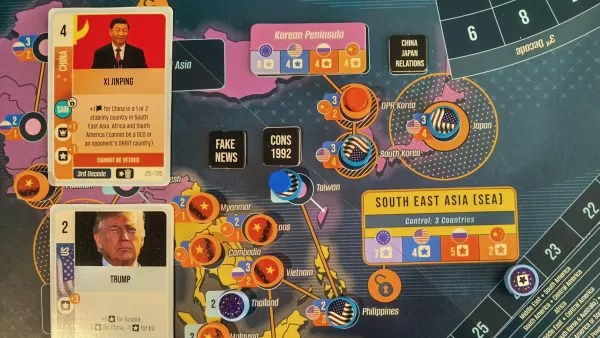
Twilight Struggle is a popular card-driven game (CDG) that shot to the top of the BGG charts in past years. Currently at the top 14 all-time, many lament the fact that Twilight Struggle was only a 2-player affair. New Cold War from VUCA Simulations tries to recapture the area control, card-driven intensity of Twilight Struggle in a 4-player game, and in the more recent geopolitical era of 1989 to 2019.
What’s in the Box
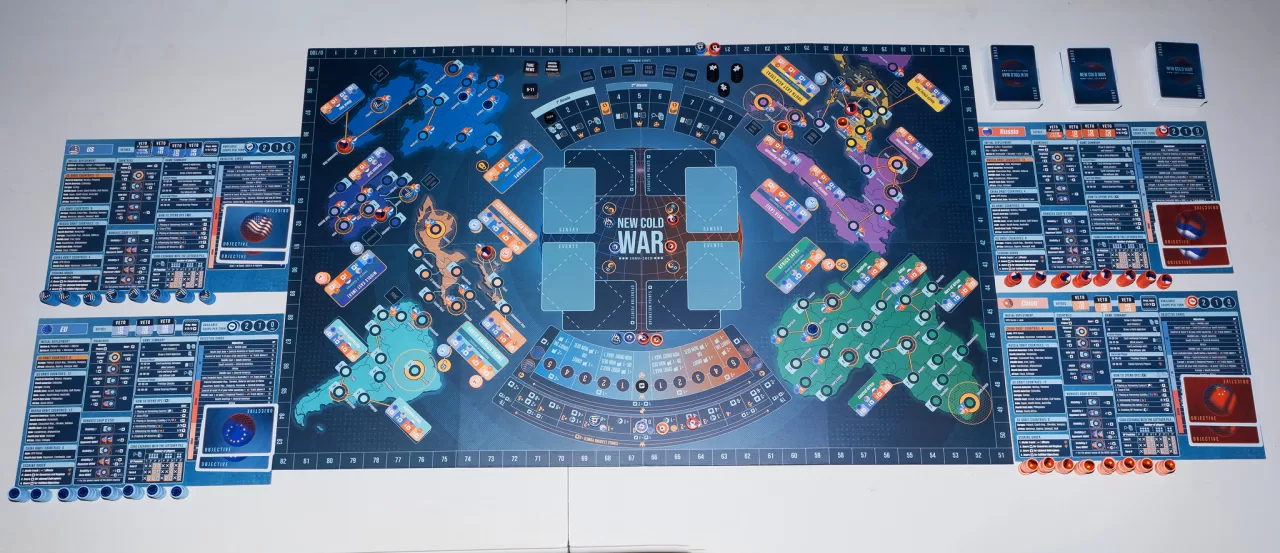
New Cold War at setup with all components sans rulebook
VUCA Simulations is a historical game company known for high-quality game production that can rival other modern eurogame quality. New Cold War does not disappoint in this aspect. The game comes with a mounted map of the world, where regions and continents are laid out in such a way that the 4 players can occupy opposite ends of the board. The game also comes with 4 mounted player sheets, each representing the great powers vying for dominance in the game – the United States, Russia, the European Union, and China. The player board also doubles as a player aid, laying down the different actions in the game and the game sequence. Being a card-driven game, New Cold War comes with 167 cards representing various events and their effects on gameplay, as noted by a myriad of icons on the cards. There are also 255 wooden discs, divided among the great powers in the game, used to mark regions of control. A number of thick 1-inch counters help denote persistent events and game effects. Lastly, the game comes with a 47-page rulebook, which may appear quite a daunting read to the unsuspecting gamer.
A New World Order
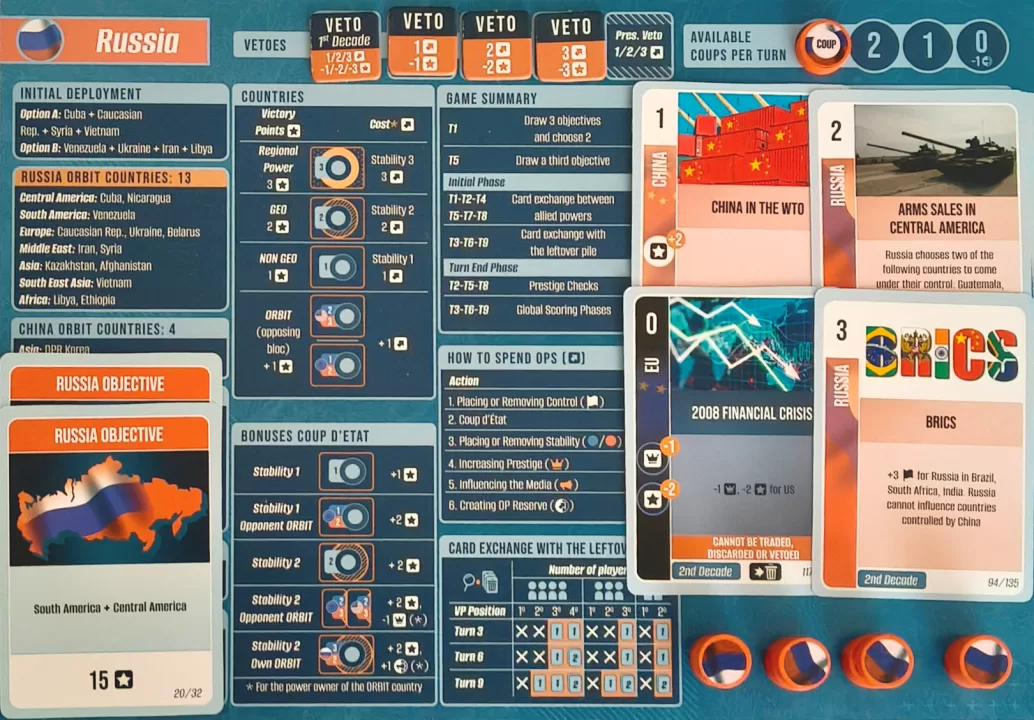
Russian player board with his Event Cards and Objective Cards. The cards are kept secret from other players.
New Cold War takes place during the 30 years between the fall of the Soviet Union and the COVID-19 pandemic. Indeed, gameplay is divided into decades, where cards are segregated into the decade in which they were historically relevant. The key belligerents, USA, Russia, EU, and China, attempt to spread influence and control to gain the most Victory Points by game end or achieve their 2 secret Objective Cards for a sudden death win.
Similar to Twilight Struggle, a game turn in New Cold War starts with a hand of cards at the player’s disposal. Also similar to Twilight Struggle, a player chooses between playing the event of the card (if the event belongs to his great power) or playing the card for OPS points to do basic actions. These actions include placing control markers on countries, initiating coups, destabilizing countries, advancing the Prestige and Media track (which gives bonuses/penalties during certain turn ends), and reserving OPS for future play.
If the player plays a card with an event belonging to another player, he is relegated to playing the card for its OPS points, and the event will be executed by the other player after. After a set number of turns, VP’s are checked and added up. Anyone who has played Twilight Struggle or CDG’s in the past will be quite familiar with the basic mechanics of New Cold War.
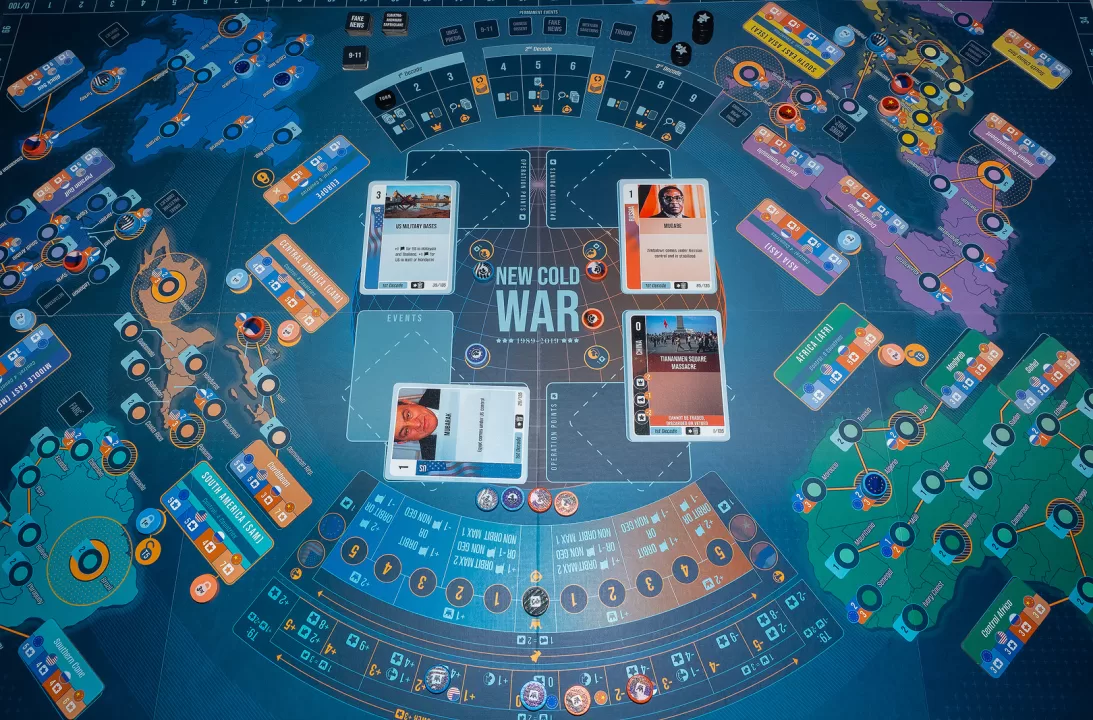
Players simultaneously pick and reveal Event Cards. The Prestige and Media Tracks appear below.
Antagonist or Ally
Where New Cold War diverges is its strong sense of coopetition between players. Each game starts with the US and EU, and Russia and China, as allies. At the beginning of most turns, allies exchange 1 card from their hand with the other allied power. Allies also work on the Media track together, spending OPS and using Events to increase their track or decrease the track of the opposed team. This Media track has shared bonuses/penalties for the allies. Playing allied cards also gives a ‘hitting two birds with one stone’ dynamic, with the active player using the OPS of the card and the event being triggered to the benefit of the ally. The game encourages allied powers to work together, overtly and covertly undermining the opposing team while splitting the world between the two. And cooperating as an alliance is one of the best aspects of the game. However, there can only be one winner, and there will come a time when the game alliances inevitably break. When to pursue and when to break your alliance really ups the intensity of the game.
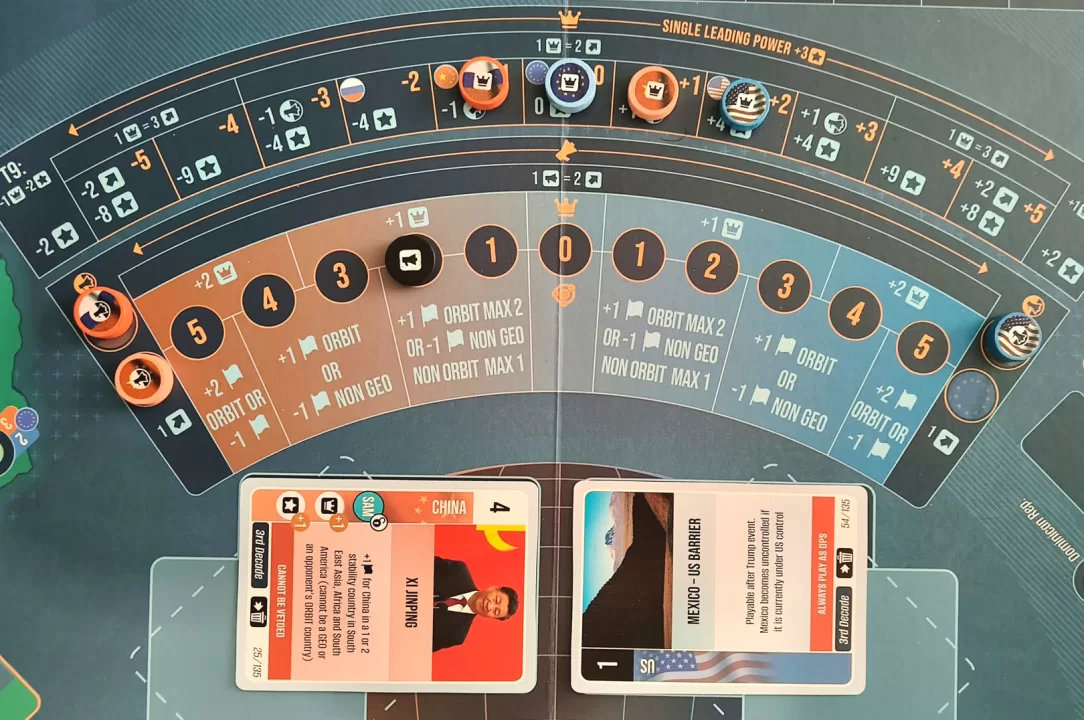
The Prestige and Media Track. An opportunity for allies to work together
Asymmetry in a different light
New Cold War is a heavily asymmetric game. But whereas most boardgames feature asymmetry through a difference in mechanics and objectives per faction, New Cold War approaches this from a different perspective. The great powers have different starting positions. China, for example, is locked to only Asia, and the EU can only operate in Europe and Africa at the start of the game. In contrast, the US and Russia can exert influence globally at the get-go. Also, the cards show disproportionality depending on the decade, with the US having more favorable cards in the first decade and China seemingly having the advantage during the endgame. Of course, this was intentional to reflect the historicity of events. Some gamers will find this a point of imbalance. And I partially agree. The game is imbalanced for new players, with the USA ostensibly stronger than the others. But in my observations, continuous play, learning the nuances of the game, proper timing of card play, using and breaking alliances at appropriate moments, leads to a more balanced and fulfilling gameplay experience. As in more complex games, especially those with a high degree of conflict, replaying the game rewards the player and the experience greatly. But for players unwilling to give this game a go beyond the first game, the experience may prove to be frustrating.
A Mirror of Our Times
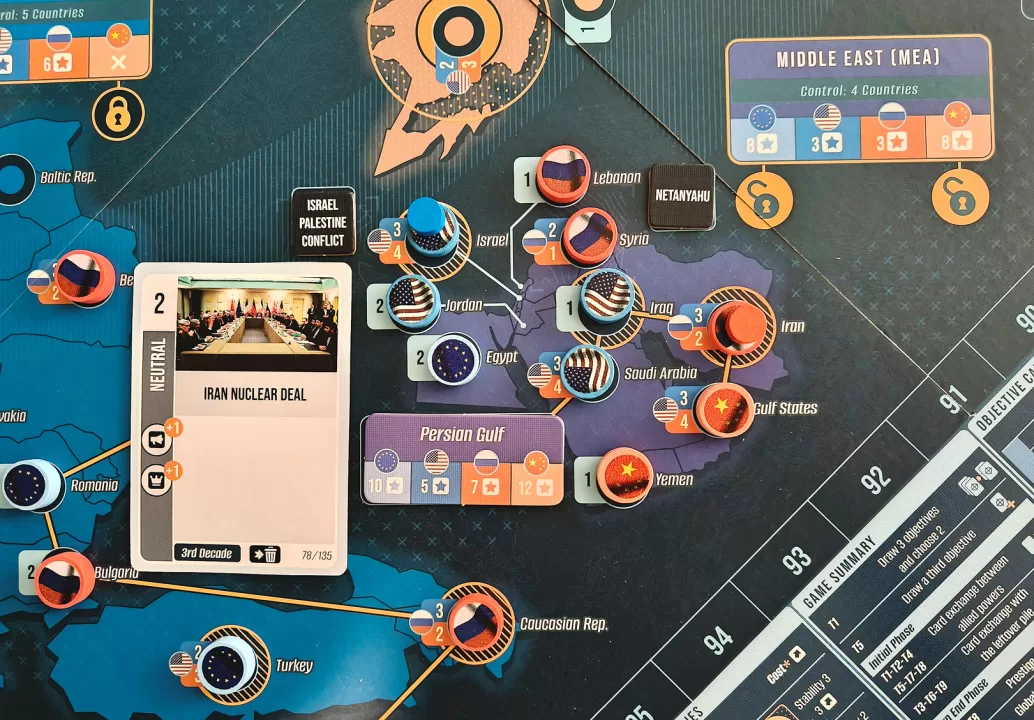
Despite the lengthy rulebook, the game itself is not mechanically complicated. In fact, the game rules account for half the rulebook only, while the rest is dedicated to playing the game solo or 2- or 3-player with flowchart bots taking over the other great powers. However, there are some rules that players may find fiddly, such as reshuffling cards into the deck. Although not a disaster in any sense of the word, I feel the rulebook could have benefited from another editorial pass to make things more concise. The game is very thematic, strongly evoking the geopolitical tension of the new millennium. It would have been nice, though, to have a reference describing the historical events in the cards, as is usually the case in historical CDG’s.
As previously mentioned, the game can be played solo or with fewer than 4 players. The analog bots are easy enough to manage, though a bot-specific player aid would have gone a long way in easing the player into handling the non-human players. In my experience, the game plays well solo but not particularly well as a 2- or 3- player game. During a solo game, all great powers are basically in it for themselves, so the game still feels balanced and competitive. In its 2- and 3- player iteration, the lack of alliances and cooperation really drags the game experience down. Thus, the game is best played 4-player or solo.
New Cold War is not a game for everybody. It is not friendly to the first-time player, and it rewards multiple plays. Its rulebook is quite lengthy, and its rules contain a certain amount of fiddliness that may turn off some. It only shines in 4-player or solo. Yet, despite these, the game experience is very positive if one is willing to give the game a chance. Like most historical games, it can double as an educational and analytical tool for current events. And as chaotic as our worldwide geopolitical situation at the moment, that might be enough of a hook for gamers to give New Cold War a go.