

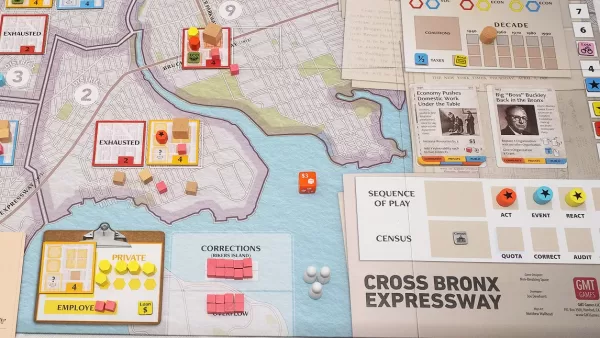
Cross Bronx Expressway is the third game in the Irregular Conflicts Series of GMT. The Irregular Conflict Series is based on the popular COIN system(COunter INsurgency) with more approachable gameplay and less nuance than its COIN forefather.
Cross Bronx Expressway (CBE) is a game about the events that shaped the South Bronx (of New York) through the 1940’s to the 1990’s and is highlighted by the construction of the titular Cross Bronx expressway which led to widespread socioeconomic turmoil.
What’s in the Box
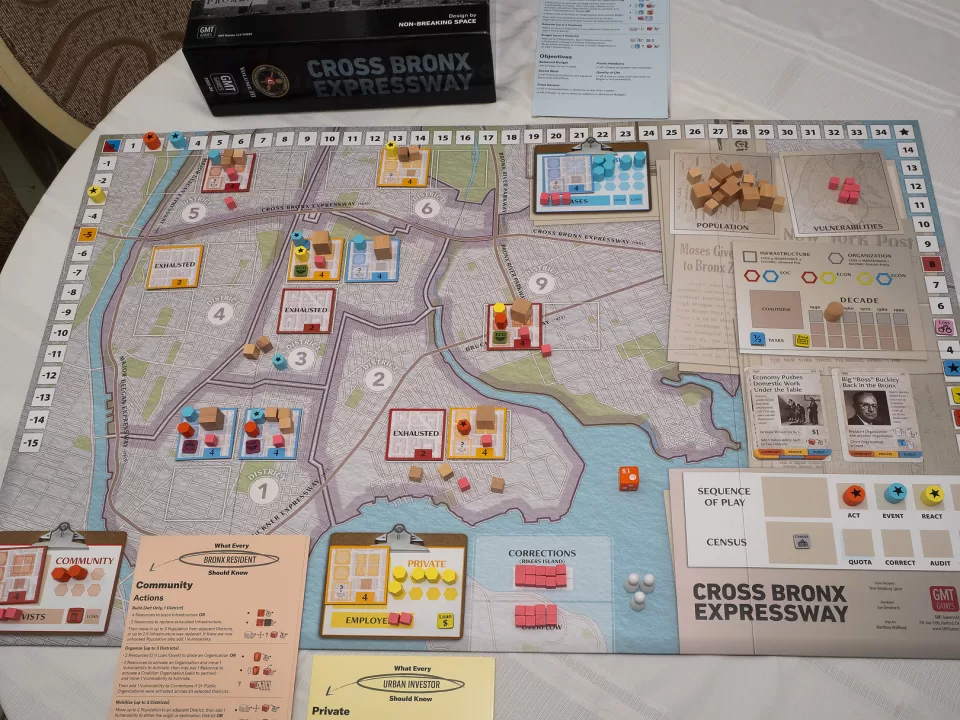
The game contains a 22″x34″ mounted game board representing the different Districts of the South Bronx and different tracks and Faction placeholders. There are 96 Event Cards and 24 Position Cards. The 127 wooden pieces represent Population, Organizations, and Vulnerabilities. The game also comes with 3 counter sheets, 3 Faction Player Aids, a custom 6-sided die, 3 Faction Orientation guides, a rulebook, and a Historical Record Booklet. Brown cubes represent Population with small brown cubes representing 100,000 people, and the large brown cube represents 5 small brown cubes. The red cubes represent Vulnerabilities which are a game abstraction that can represent anything with negative effects on a community, such as crime, unemployment, and mental stress. The hexagonal cylinders represent the different Faction Organizations, which represent collections of institutions operating within a District for a particular interest. Organizations have two sides, with the star side up indicating an activated (i.e., used) Organization.
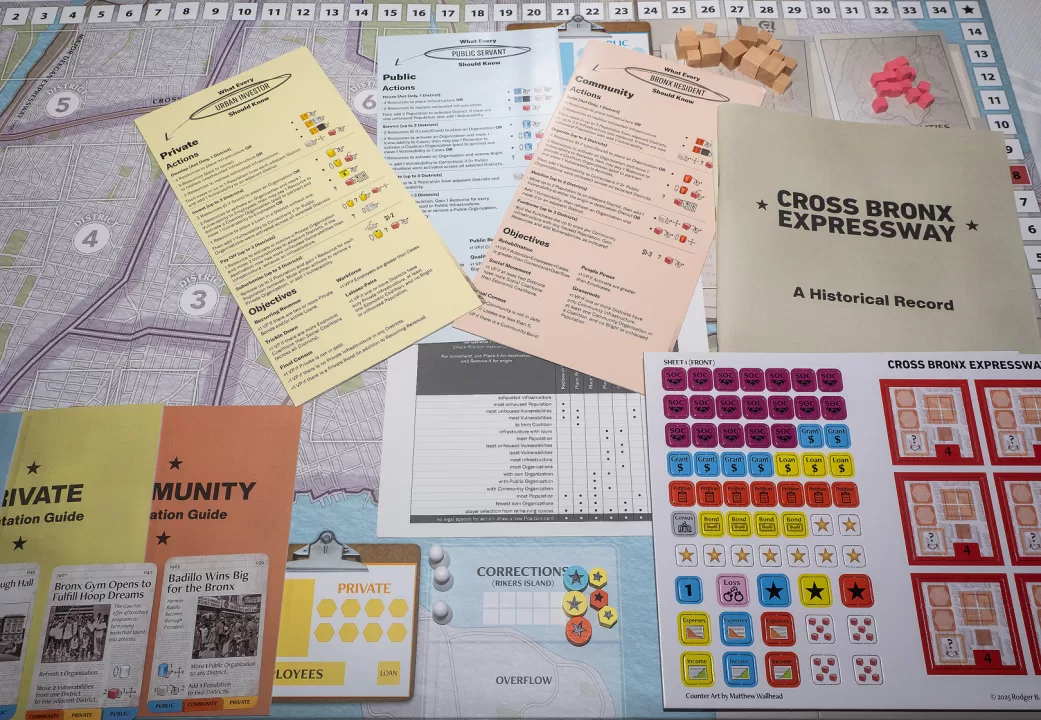
Components of the Cross Bronx Expressway
Burning Down The House
CBE is a 3-player game, although the game comes with dedicated Non-Player bots for solo or 2-player sessions. The players represent the different Factions with stakes in the South Bronx area. The Public consists of government entities such as firefighters, police, and social workers who try to balance the socio-economic interests of the Bronx. The Community represents resident organizations such as local businesses, immigrant groups, non-profits, and gangs. The Community tries to build a sense of communal self-determination by supporting local activism and making sure there are ample social services. The Private faction represents bigger business entities, such as banks and large property owners. Their goal is to create new economic opportunities by investing in the South Bronx and forming economic zones and coalitions. CBE is semi-cooperative, so factions have to work together to make sure the city doesn’t fail, but also try to score the most victory points by game end. CBE is also an asymmetric game, so each faction has its own way of scoring victory points and playing out actions.
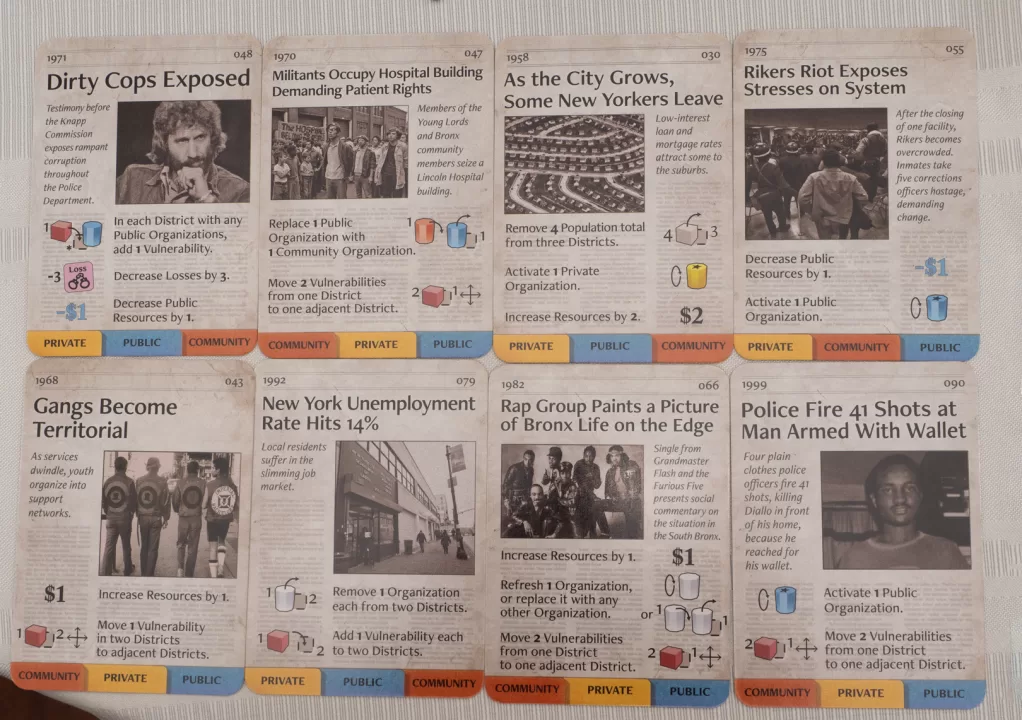
The game is driven by Event Cards. These represent historical events and personalities, and most will have detrimental effects on the South Bronx, especially in the later decades. Players are tasked with mitigating the effects of these events and other player actions by making sure populations are housed, vulnerabilities are controlled, finances don’t go bankrupt, and organizations are present to combat the negative effects of blight and answer the call of petitions. Each faction will have Actions to lay down Infrastructure, place or activate Organizations and Coalitions, move Population, and gain Resources; although the requirements and effects of each faction slightly differ. For example, the Community can Build Infrastructure by paying 4 Resources and moving up to 3 Population from adjacent districts, while the Public would House Infrastructure by paying 4 Resources and adding 2 Population. Laying Infrastructure is used to house Population and Vulnerabilities and Organizations are activated to deal with Vulnerabilities (especially unhoused ones). Basically, any unhoused Population and Vulnerabilities will cause problems.
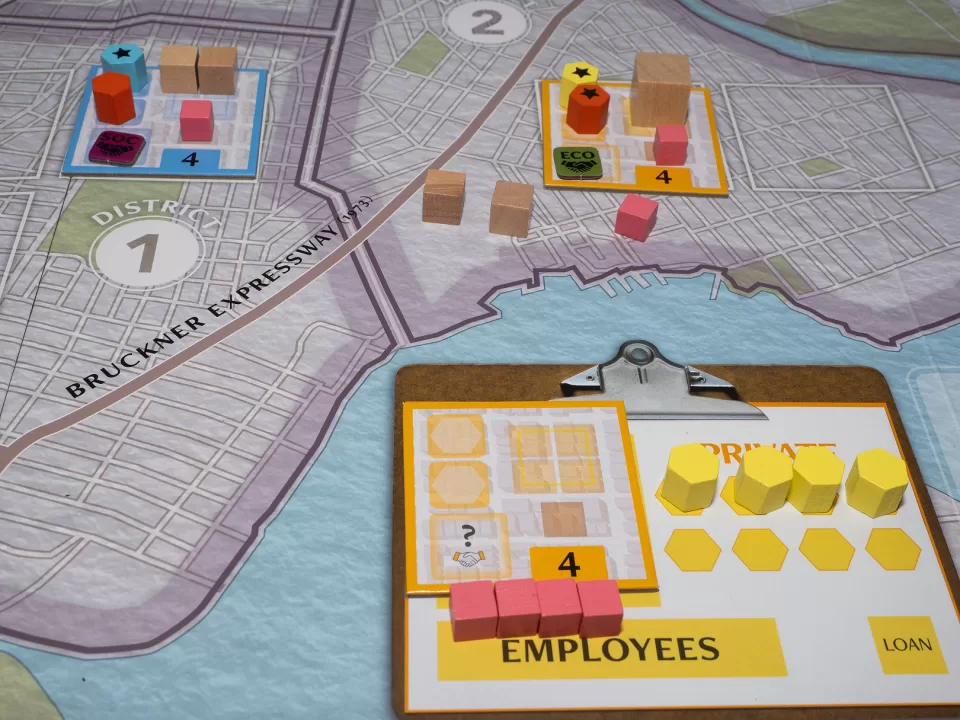
Activating Organizations remove Vulnerabilities by transforming them into productive members of society, such as Employees.
Each game is composed of 2 decades, with 8 random Event Cards played per decade and a Census at the end of each decade. Each turn starts by playing an Event Card from the top of the deck. At the bottom of each Event Card are player faction orders. The first Faction gets to choose whether he/she will ACT and perform one of their asymmetric Actions in up to 3 Districts, execute the EVENT, REACT, which is performing a single Action in 1 District, or PLAN, which allows the player to refresh one of their Organizations and gives him/her initiative to choose first during the next Round. The next Faction chooses from the remaining options, and the third chooses whatever options are left.
Play continues until the Census Card is drawn. During this round, unhoused Vulnerabilities and Population are assessed, with excess Vulnerabilities heading to Corrections and Overflow. Losses are increased by the number of Vulnerabilities in Overflow and if Losses are 8 or more, the game ends in Disenfranchisement and all Factions lose. Additionally, income and expenses are calculated for all Factions, and if Public and Community fall into a combined debt greater than 14 Resources, the game ends in a collective Bankruptcy loss. Lastly, Objectives for each Factions are tallied, and the board is reset. A new set of Event Cards from the next decade is played, and the game ends after the last Census (if no collective loss condition was triggered), and the player with the most Victory Points wins.
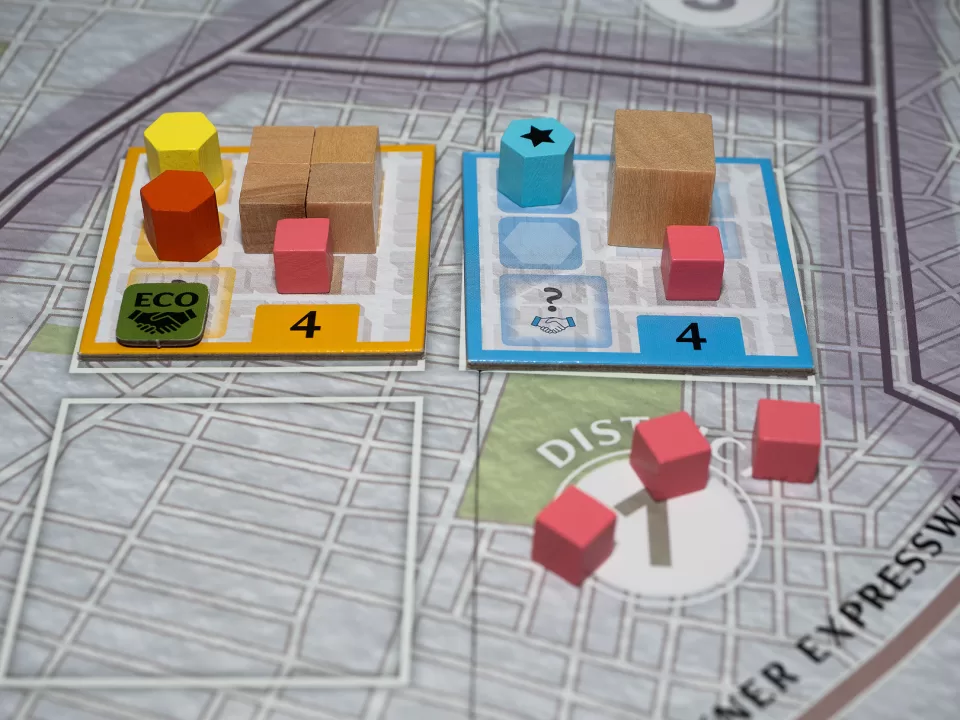
Controlling unhoused Vulnerabilities is key to survival in CBE
Moderating your Greed
Cross Bronx Expressway is the maiden design of Non-Breaking Space, a designer who once lived in the South Bronx. The game contains a chock-full of New York and world history, mainly through the Event Cards and Historical Record booklet. However, gameplay-wise, it is quite abstract. Players familiar with the Irregular Conflicts or COIN series will find this title to be the most abstract and least asymmetric offering. This might lead some to think that CBE is less thematic, less simulation, with less conflict. But the rulebook clearly explains what these abstractions are supposed to represent. There is theme, interaction, and conflict here, and for those who read the rulebook, these game mechanics and abstractions will make full sense.
CBE also departs from the usual rules format of GMT Games. The base rules are in the rulebook with margins containing explanations and thematic connections to the rules. This makes one think the margins contain optional flavor text, but from my experience, they are essential in fleshing out the game, as many of those points explain the game’s abstractions. It is also worth noting that reading at least one of the Orientation Guides is essential to understanding the game. As mentioned previously, this game plays quite differently from the series.
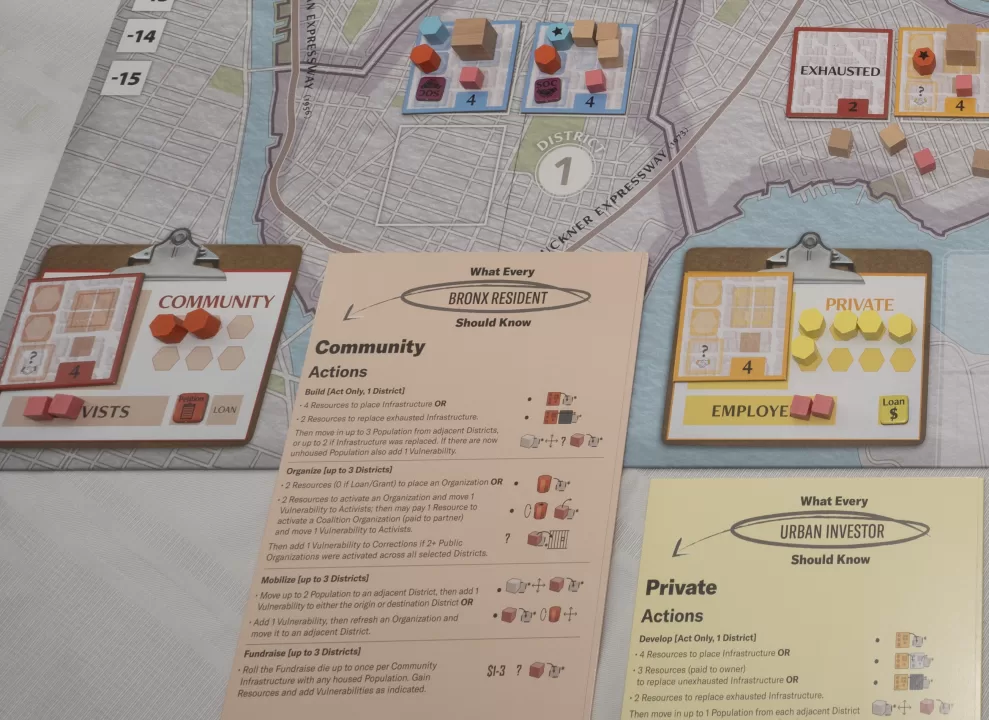
The Community player carefully assesses his options using the Player Aid.
CBE is very different from other coopetition-type games in that it can be very easy to lose the game collectively especially in the later decades. The game has a more pronounced cooperation aspect. Coalitions encourage cooperation amongst players, and players would be wise to use this to their advantage. Especially since the game actively works against the factions, mostly via the effects of the Event Cards. However, the game’s asymmetric Objectives also provide lots of friction as Objectives of the Factions are diametrically opposed to each other. Thus, accumulating Victory Points by Private could hurt Public but could also inadvertently lead to a collective loss. Victory points are difficult to achieve, and they are few and far between. This is a low-scoring game, thus the temptation to push for these Objectives is ever-present. It’s this fine balance of doing what is best for all versus what is best only for you that adds to the game’s unique flavor. As one political figure once said, you have to moderate your greed so that the system as a whole does not fail.
A Story of Survival
As already noted, Cross Bronx Expressway is not your typical city builder. It is not about gathering the most resources and constructing the highest buildings. It is about the aftermath of a city trying to survive when forces larger than itself affect its socio-economic framework, usually to the detriment of the city and its inhabitants. It’s a game about neglect, loss, ruin – how a system can utterly fail and how different groups try to survive among this greed and lack of concern. Thematically, it can be heavy to play, as players try to keep their city (borough) alive while dealing with misused government funds and an increasing homeless population. As depressing as that may sound, it’s this theme of near socio-economic collapse that attracted me to the game – it mirrors my hometown of Manila to an extent. Playing it and barely winning gives me a sense of hope. In fact, just surviving through the end, no matter who wins, is an emotional victory as well.
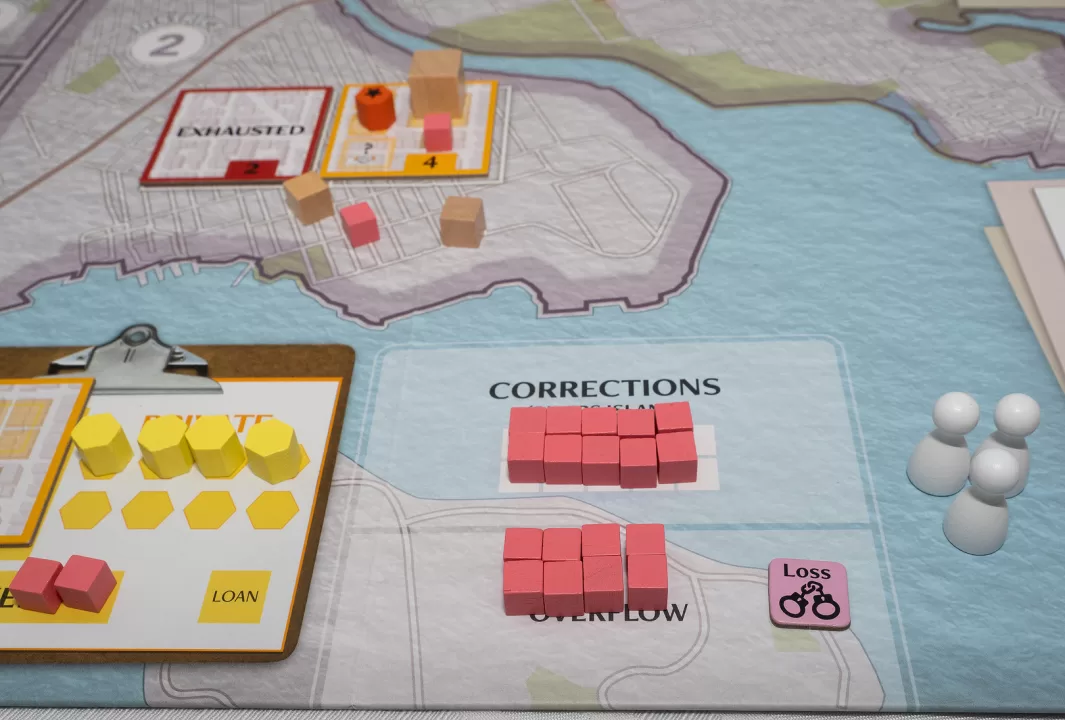
Corrections cannot accommodate more than 10 Vulnerabilities and an Overflow can lead to a collective Loss.
CBE as a game system works well. It is easy to play once players get past the irregular rules. It is a 2.5-hour game once you’re comfortable with the mechanics. It has interesting city survival elements with a high degree of cooperation and interaction. And it is also fairly abstract. And this abstraction could make it a good candidate for other cities to be simulated by the CBE system by fleshing out a few of these abstractions and (of course) replacing the Event Cards. So this could be a series within a series, I think.
Can the game provide a real-world framework on how to deal with these problems? I’m not sure. Probably not. And yet, despite its abstract nature, I’m sure there were some lessons and insights I gleaned from playing it. And that’s probably its greatest asset – the potential to teach players lessons of survival from utter collapse.