

It has been over a year since I first reviewed the game, and now, I’m back playing Civilization VII to test out the big Test of Time update. This free update was released nearly a month ago as of writing, and since then, I have played a couple of full runs. Given how big the additions are in this update, I feel like I still need to play more if I want to do a “full” review, so instead, I’m going with more of a quick review to get my thoughts out regarding the game.
Before that, I need to reiterate that I rated Civilization VII quite highly in my review. There, I praised the game’s new structure, which made the endgame much more manageable. This addressed the problem of me not finishing games, as endgames in Civ 5 and 6 can feel a bit tedious, or unnecessary if I’m steamrolling my AI opponents. As such, this quick review of the new update is from the perspective of someone who liked the overall direction of Civ VII.
I did dedicate a chunk of the review to the fact that the civ-switching mechanic won’t be to everyone’s liking, especially considering how guiding a single civilization through the ages is a big part of the series’ appeal. While I didn’t have that big of a problem with this, a significant portion of Civ fans did not like this change at all.
Given these responses, it makes sense that Firaxis released a big update that addresses this exact issue. In the Test of Time update, players can finally choose one civilization and stick with it throughout each run. As the game is built from the ground up with civ-switching in mind, this is a massive change, and it’s no surprise that it took over a year before this update was released.
Time-Tested Civilizations and How They Work

Before this update, each run lets players select a civilization in the Antiquity Age, but with each Age Transition, players have no choice but to switch to a new civ. With Test of Time, the game now lets players choose whichever civ they want at the start, and then choose to carry them over through the Ages. Yes, this means players can select even Modern Age civs like the French Empire or Meiji Japan right from the get-go.
Given that each civ was originally made specifically for a certain age, they are still much more powerful during their Apex Age. For instance, while you can start as America, you won’t be able to build its Unique Units and Infrastructure until its Apex Age (in this case, the Modern Age). On the flip side, for Antiquity Age civs like Rome, you can build their Unique Units and Infrastructure at the start, though their utility does go down in the later ages. Plus, while you’ll still be able to build Infrastructure later in the game, Unique Units will be locked out of production.
As for Unique Abilities, these passive buffs are there throughout the run, but their numbers have been tweaked. Thus, civs originally designed for the Exploration Age will have their Unique Ability numbers higher in this age compared to the other two. This should make the Apex Age of each civ more impactful.
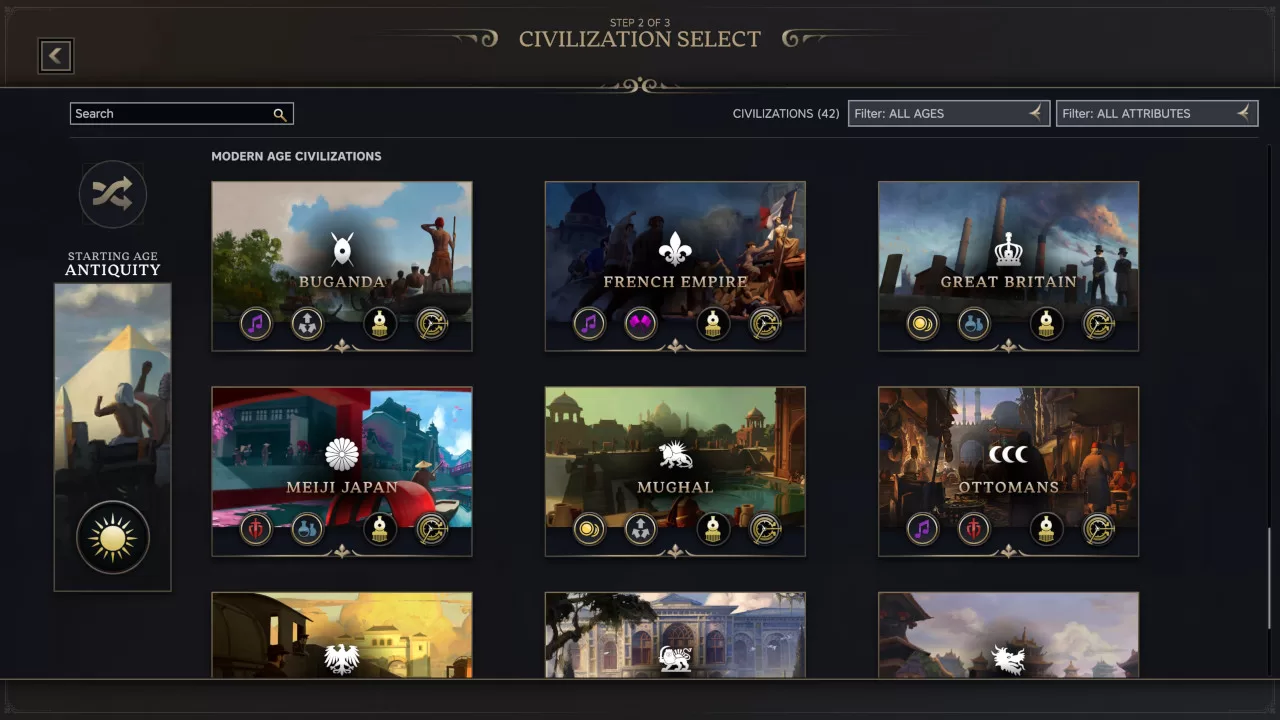
Each civ’s Civics Tree has also been tweaked so that they can be accessed throughout all three ages. Note that, because of how many civs there are, the civic trees for each can feel a bit cookie-cutter in the non-Apex Ages. As such, each civ’s identity is felt much more in their Apex Age. While I wouldn’t go as far as to say the non-Apex Ages feel a bit barebones, I think future updates or an expansion can do a lot to help in this regard.
What’s also worth noting is that Leaders being divorced for Civilizations still feel a bit weird. Still, this isn’t exactly something that can be changed without a complete overhaul of the game’s systems. If you ask me, the Test of Time update balances this well. The update marks a return to one civ throughout the run without throwing away the identity of Civilization VII.
A Welcome Return Without Going Full Course-Correct
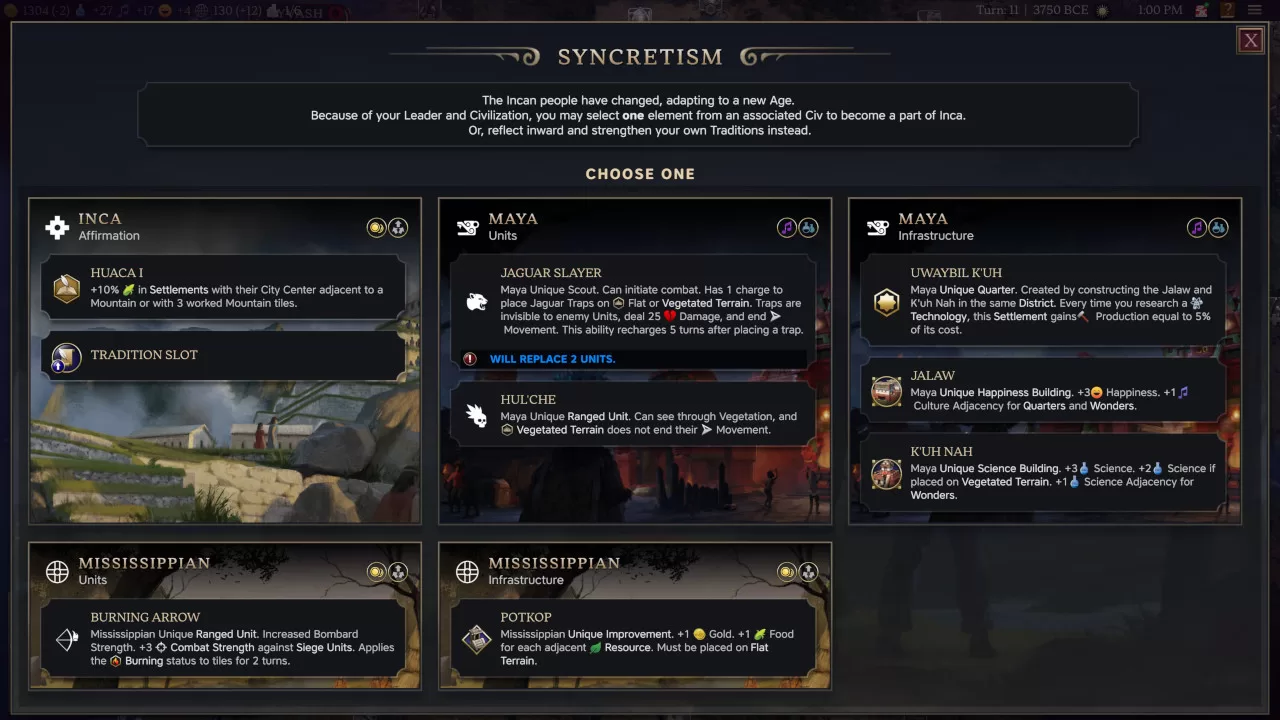
From a gameplay standpoint, Syncretism is one of the more important additions in making one civ throughout each run work. Syncretism is part of the civic tree, and by researching it, players can choose an element from another civ that they can integrate into their own.
Specifically, there are three options. One is the integration of a Unique Infrastructure, meaning players can unlock a Mayan building as the Inca. Players can also choose a Unique Military Unit instead, which is useful for players who want to go the Domination route and are in a non-Apex Age. Finally, players can choose an Affirmation, which adds a new Tradition and a slot.
While I said above that your civ’s identity is less apparent during a non-Apex Age, the addition of Syncretism helps a lot on the gameplay balance side of things. With this, playing a Modern Age civ in Antiquity doesn’t feel limiting or particularly underpowered.
In this regard, the ages and transitions are still a core part of the gameplay experience. This is great, as Firaxis could’ve instead gone all out in course-correcting by gutting out the core identity of Civ 7, which has the danger of pretty much pleasing no one (think of how Rise of Skywalker course-corrected too heavily from The Last Jedi, resulting in pretty much everyone disliking or being indifferent towards it).
Civilization VII Test of Time Update – Initial Verdict

Overall, this new Civ VII update is a big step in the right direction for the game, as it addresses a major criticism from fans regarding civ switching. What’s also great is that the update lets players stay as one civilization for an entire run while still keeping Civ VII’s signature mechanics intact.
As such, players who haven’t been playing the game should definitely try the game out again. Of course, while these changes may not be enough for some long-time fans, we can see the game improving even more in future updates, or when the first big expansion eventually gets released.
Civilization VII Test of Time is out now as a free update for all owners of the base game. As for the game itself, Civilization VII is available now on various platforms, including practically all major home consoles, PC, macOS, Linux, and iOS.