

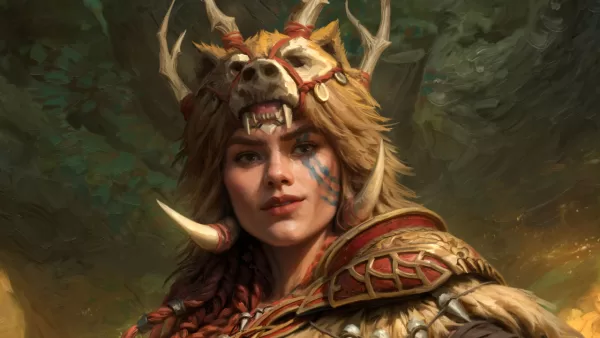
Recently, we got a chance to chat with Diablo Immortal devs about the game’s latest class – the Druid.
In case you missed it, Blizzard announced that the Druid will be added into Immortal later this week as the game’s ninth playable class. This is an exciting addition for many players given that the Druid is a beloved class that has appeared in other Diablo games since it debuted in Diablo II.
Of course, the Immortal dev team didn’t just aim to copy the Druid from Diablo II or IV. Instead, they wanted to make this class feel familiar, all while having unique elements that make them stand out.
This goal, coupled with the fact that Diablo Immortal plays quite differently from the other mainline series entries, meant that the Druid’s development had some interesting challenges. These challenges were among the topics shared by Senior Narrative Designer Ryan Quinn and Lead Systems Designer John Yoo during our recent interview.
[The following is a transcript of our interview with Quinn and Yoo, edited for clarity.]
Given the scale and variety that you aimed to bring with the Druid in Diablo Immortal, what were the specific challenges you faced during the development of adding the Druid to the game?
JY: There was a time, for sure, when there were a lot of abilities that we just kept iterating on—we needed to spend more and more time polishing them to make them feel right.
For instance, the Stag ability. The first implementation of that ability just felt really strange. You felt like this fanciful deer hopping around the map, and we were like, “This feels weird.” We weren’t even sure if we could get the kind of impact we were aiming for with what we were trying to do there.
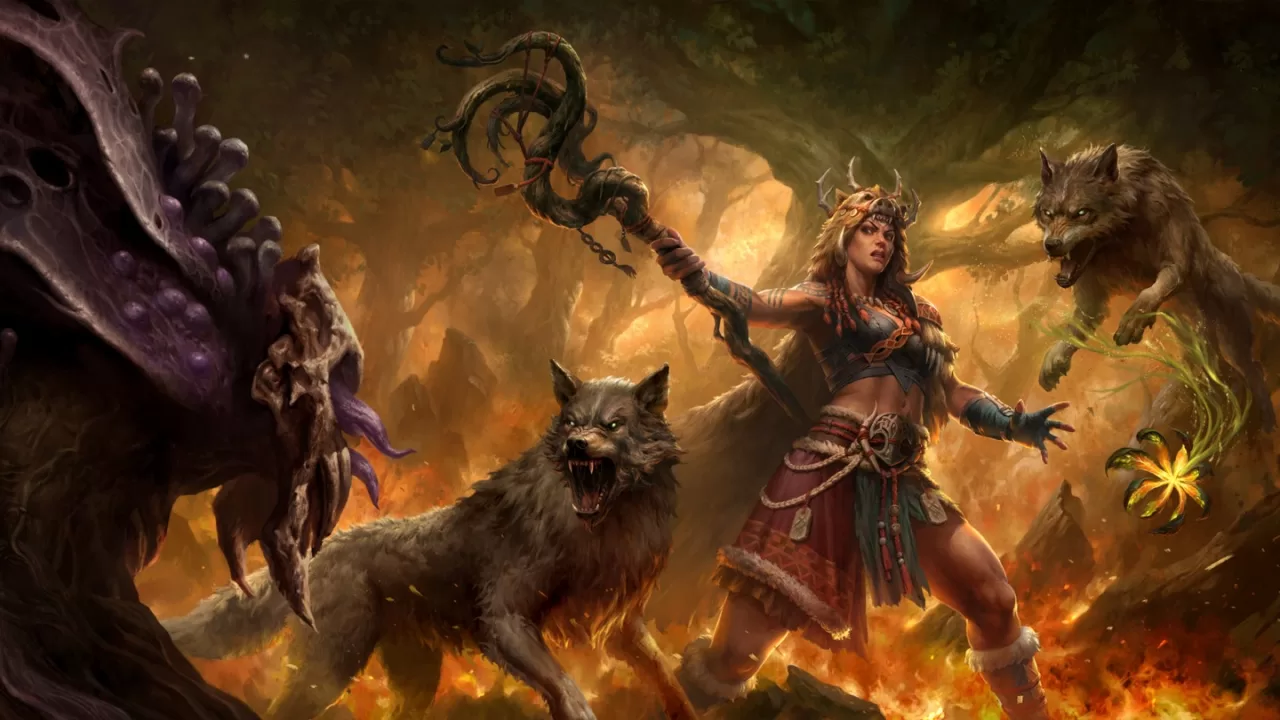
Same with the Raven form and all these new things we were testing out. When we were trying new summons—we eventually landed on summoning wolves, which is traditional to the Druid—but we didn’t start there. We actually began with dire boars because we wanted to be unique. These Druids were from the Sharval Wilds, so we imagined they’d have different summons compared to conventional Druids.
But at a certain point, we had to be honest with ourselves. We looked at the dire boars and were like, “These look weird. They don’t look menacing—they just look off, they feel awkward.” So we said, “Let’s just go back to wolves.”
It was about trying so many different things. Like I said, even though it’s a familiar class, we knew we had some flexibility with a lot of the abilities. So we experimented—trying to see what transformations we could come up with for our version of the Druid. It was a lot of testing, seeing what worked and what didn’t.
We also introduced gameplay elements unique to the Druid class. Narratively, Brian and his team were talking about how this version of the Druid is really chaotic—they feed into their own power, which can be unpredictable. That led us to develop a resource meter exclusive to the Druid called Primal Power. It acts as a resource for powering up some of their abilities. So that narrative direction really helped us develop gameplay mechanics that tied everything together.
So yeah, it was just about trying. Trying a lot of new things. Same with skills and ability sets. That’s the big thing when you’re making a new class or developing something fresh—it all starts as a bunch of crazy, cool ideas. But once you begin implementing them, it’s about being honest with yourself and figuring out what works and what doesn’t.
RQ: From my perspective, you know, we talk about legacy a lot on the team. We think of Immortal as the sequel to Lord of Destruction, and the Druid is obviously this fairly high-concept fantasy that comes with a lot of expectations. So on Team Immortal, on the creative side, it’s really important for us to strike that balance between the new and the familiar.
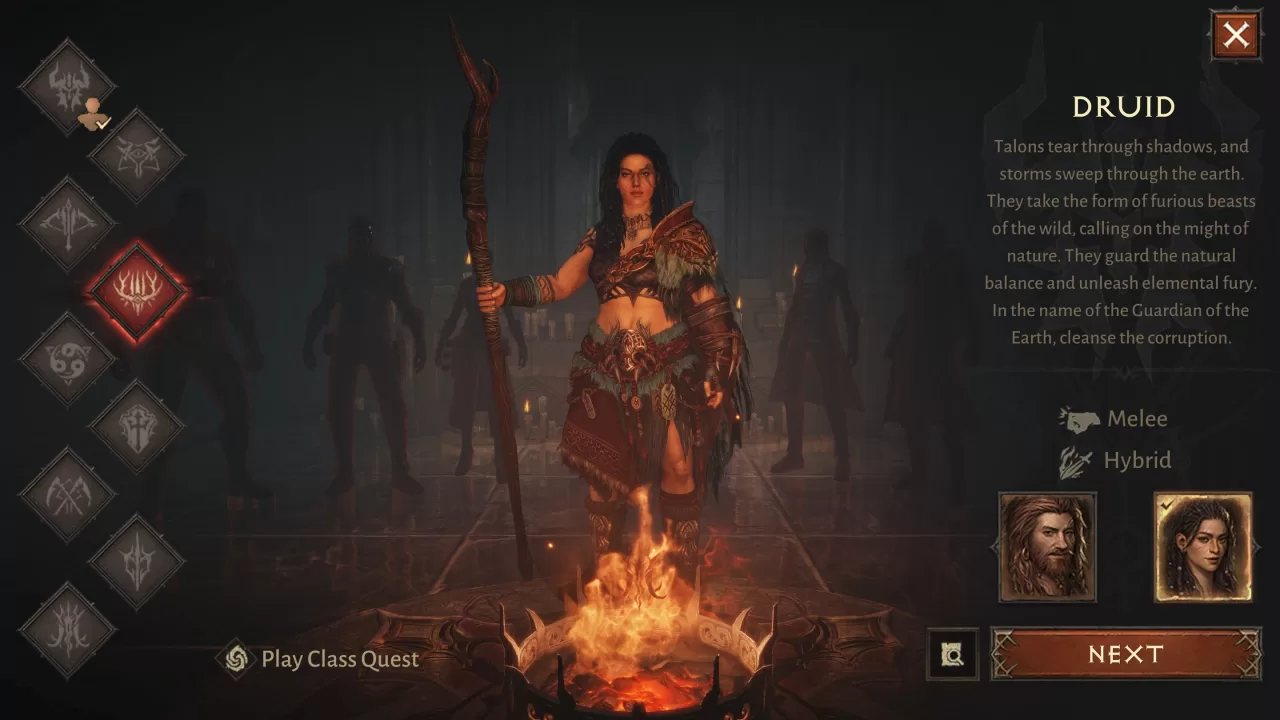
We want you to be able to look at the character’s silhouette, see their abilities, and go, “Okay, yeah—that’s a Druid.” There are elements of the Druid’s Diablo II legacy that we absolutely felt we couldn’t jettison just for the sake of being weird or fresh. You know—gotta have the werewolf. Gotta have the werebear.
But then we looked at how much familiar and how much new we could bring in. How do we strike that balance and really dial it in? Like John was saying, some things are just classics, but we can still tweak them in interesting ways. You can have a wolf summon, sure—but then you equip a legendary item that sets them on fire, and suddenly you’ve got these barghest-style, fire-breathing wolves.
We also came up with a new take on an old favorite—like the Oak Sage. We kept the HP and defense-oriented support ally vibe, but gave it a new twist: with certain legendaries, it can fire off little homing blasts to help control the battlefield. And visually, we gave it a look more reminiscent of the Sharval Wilds.
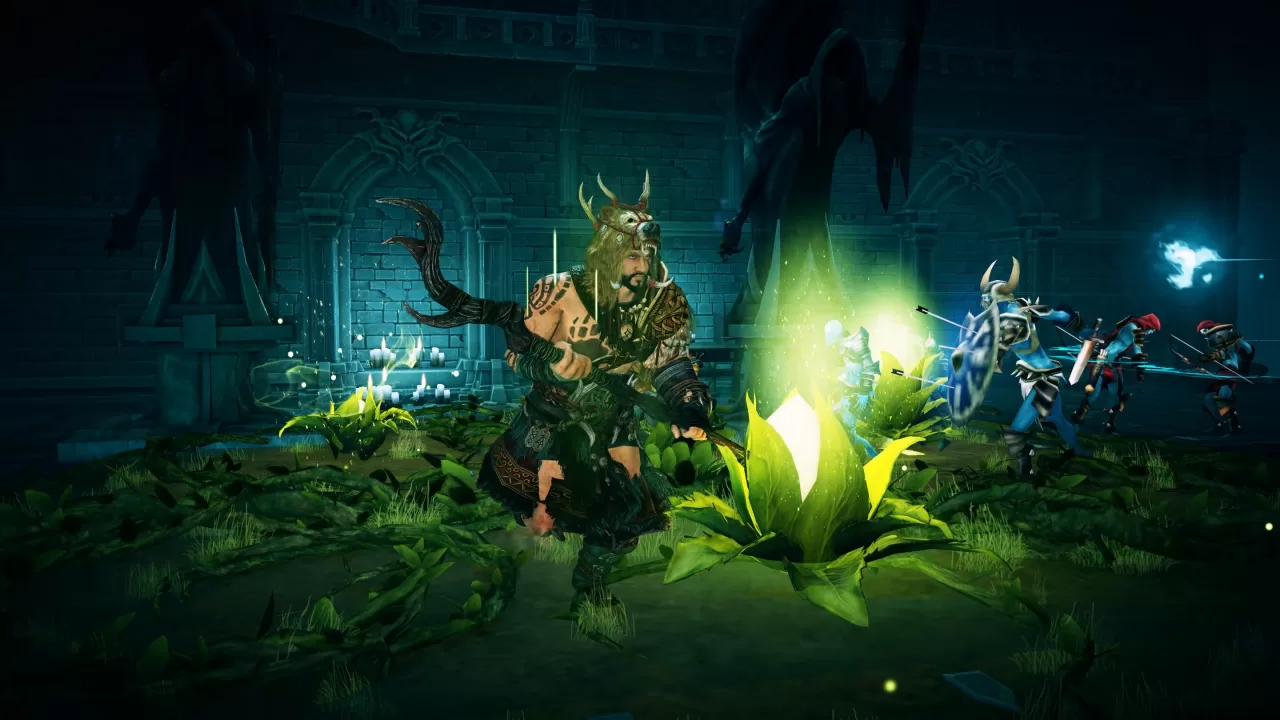
Then there were times we wanted to do something completely new—something that didn’t break the Druid fantasy, but wasn’t something we’d done before with past Diablo Druids. My favorite example is something that came out of a collaboration between narrative, systems, and art: a feature called Circle of Life. You see this bramble circle sweep around the Druid’s area—this kind of Ogham-inspired rune wheel in the center. Little bulbs appear—glowing, green, rampant growths—and you can interact with them for bonus health restoration.
It looks wild, untamed, and very on-theme for the Sharval Wilds, while also accomplishing a bunch of design goals: making healing more interactive and cementing the idea that these Druids are from bramble thickets and trapdoor spider havens.
And getting there—dialing in something new on top of a pre-existing fantasy—that, to me, is the most challenging part.
How has player feedback or reception of the previously released classes factored into the development and addition of new classes? Especially the Druid in Diablo Immortal.
RQ: I unfortunately think the answer to your question is—it’s kind of both. We digest feedback—we’re voracious with feedback—but we also have, I think, after a long time making classes together, pretty strong design instincts and a good idea of what we want to accomplish. So we try to let both of those things inform class design.
We don’t want to get to the stage of design by committee. But, for example, aesthetically—you know, the Blood Knight and the Tempest—I love them both dearly, but they’re both unique. They’re both somewhat unfamiliar to players. So we had a lot of players saying, “Oh, this is really cool, I love that you’re taking this tack with a kind of vampire/Renfield-type class fantasy.” But then we had others saying, “Well, I’m not really sure what this guy is about,” just looking at the key art. Or, “This is cool, but it’s too Gothic, too violent, too brutal for me.”
Everyone’s got different preferences, and sometimes when you try to accommodate one preference, you end up closing doors to another. So generally, what we try to do is look for opportunities. What haven’t we done yet? What are we excited about? And then—what have we learned from past experiences? Things like transformation skills, conditional attacks—lessons we can apply to a new class’s development.
That informs everything, in my experience. It informs art, sound design—even the personalities of our characters. The Blood Knight is very haughty, kind of aristocratic. The Tempest is very socially minded—diplomatic, noble, dedicated. The Druid? None of those things. The Druid lives by instinct, responds to their own whims and feelings, doesn’t really care about society. They don’t have a dark fate—they’re just living their life.
JY: On the gameplay side, we definitely gather a lot of feedback before making any major decisions. For instance, even before we officially greenlit the Druid, we had to talk to all the other departments. We spoke with marketing and publishing to find out whether the Druid was something the public actually wanted. We sent out polls and collected that feedback to see if players would be excited to see the Druid in Immortal.
We also consulted with the Diablo II and Diablo IV teams to hear their thoughts—whether they felt doing the Druid again was a good direction, based on how it had been received in their games.
Even once development started, we began by listing abilities on paper. From there, we sent out anonymous internal surveys to collect thoughts on those abilities. So yeah, we’re always gathering feedback.
The reality is, in game design, feedback is critical to the success of whatever you’re building. Not listening to what people are saying just isn’t healthy. You really have to be objective and open to what’s being said.
No matter how much we might be enamored with an idea—if it’s not something people are asking for, it doesn’t matter. The only thing that really matters is whether players are enjoying it. We’re building this for our players. We want to create something we think they’ll love—not just something we want to make. In this case, it’s all about the player. They’re the final judge.
Ultimately, once the Druid goes live, we’ll be gathering even more feedback. We’re looking forward to hearing what players say, and we’ll continue to iterate and evolve from there. But yeah—we’ve definitely done our homework in gathering feedback at every step of the way.
When it comes to new content, how do you balance making Immortal a unique experience on its own and not just a Diablo 4 lite, all while still keeping it a “Diablo” experience?
RQ: Diablo is a gothic horror game, and gothic horror needs tension. You need to see monsters wind up. You need to have some understanding—some ability to predict what they’re going to do.
But Diablo is also an action fantasy game, and a lot of our encounters happen really fast. So you need to make sure everything reads clearly—even on our smallest screen, which is the mobile phone. Sometimes, those two things can be in tension with each other.
From an aesthetic perspective, what you really want are the high highs. You want a lot of moments where players are using that tremendous speed and responsiveness that comes from mobile’s fine-grain button-touch controls. But you also want those moments of dread—of ominousness—that people remember.
You won’t necessarily be able to pack both of those into every second of a class’s play. So the question becomes: when do we achieve column A, and when do we achieve column B? You space them out—and make sure both come through, loud and clear.
JY: We’re in a weird situation with Immortal in that our combat feels very different from traditional Diablo games. The older games use a standard health and mana system—we don’t have mana. We’re cooldown-based. So our combat style is very different.
The biggest thing for us, when developing a new class—or even an existing one like the Druid—is making sure it still inherits the core principles that people associate with it. Things like summons, transformations—those are essential. We’d be doing the Druid a big disservice if we didn’t include those. So we knew from the start: we had to incorporate that.
At the same time, we want to put our own spin on it. Because our game is different—it’s cooldown-based, it’s on mobile, it’s free-to-play. There are just so many elements that make it a radically different experience. But we still share the same universe, the same narrative. So we have to uphold that as well.
That’s how we try to strike the balance—by staying mindful of both sides. Honoring what’s already been done while also designing gameplay that fits Immortal.
The Druid will arrive in Diablo Immortal on July 3, 2025.