

The Dietz Foundation is the only non-profit gaming publisher in the USA. Most of their games focus on non-traditional educational methods. Their proceeds are used for high school and college educational scholarships, and for providing teachers with grants to pursue the use of games as an experimental educational tool.
Their most successful game is the Littoral Commander (LC) series. Designed by Sebastian Bae, a former Marine and a research scientist in the American defense industry, it is a grand tactical educational wargame aimed at teaching Marines modern battle tactics. The game can be played by 2-6 players and has a playing time of 45-240 minutes.
What’s in the Box
So far, there are 2 games in the series, Littoral Commander Indo-Pacific (LCIP) and Littoral Commander Baltic (LCB). Each game comes in a rectangular box with 2 or more sheets of counters, paper maps, a rulebook and scenario book, JCC cards, Unit Trackers, 10 20-sided dice, and colored cubes. LCB is the newer game and features a newer map design and updated military equipment.
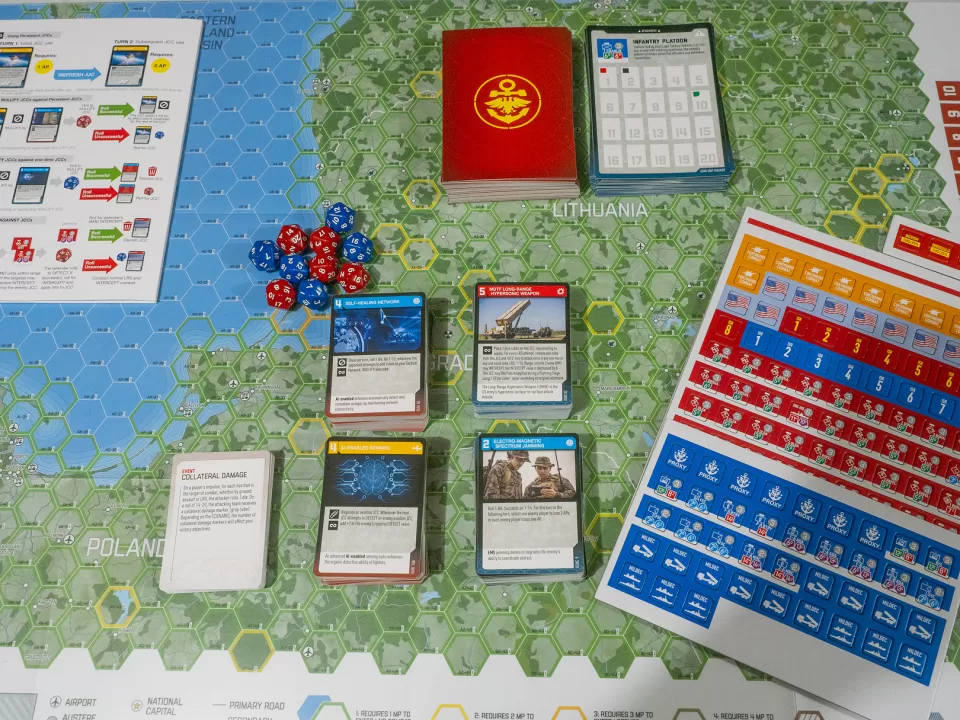
Game components sans colored cubes
Simulating the Modern Battlefield
At its heart, Littoral Commander is a hex and counter wargame. The chosen scenario dictates the Order of Battle and the unit counters to be used. Players are divided into 2 teams: the US vs China (LCIP) or Russia (LCB). The players on each team take control of a Task Force composed of a number of units represented by counters. Each counter has its own Unit Tracker that allows players to keep track of a unit’s HP and supply levels. Unit counters are deployed on the map face down, so the opponent is unaware of a player’s force composition.
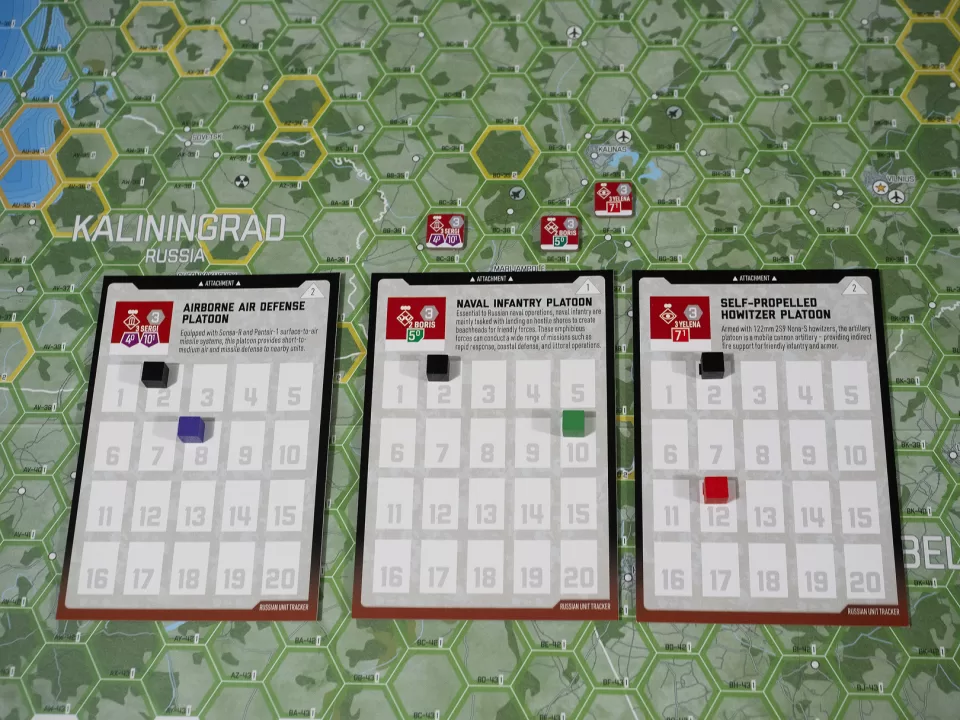
Unit Trackers make it easy to keep track of supplies and unit health.
The game has 5 phases – the Planning phase, the Deployment Phase, the Action Phase, the Initiative Check, and the Victory Check. During the Planning Phase, players choose Joint Command Cards (JCCs). These represent support from higher command and can range from attacking units (like strategic bombers) to cyber attacks. Deployment is when units and task forces are laid out on the map.
The bulk of the game consists of the Action Phase, where players move units, play JCCs, and engage in combat. The Action Phase is divided into Impulses, where Task Forces from both sides alternate in activating and doing Core Actions. Movement and combat rules are easy to implement, with all pertinent information printed on a unit’s counter. Combat is resolved through rolling a d20, with lower values being better.
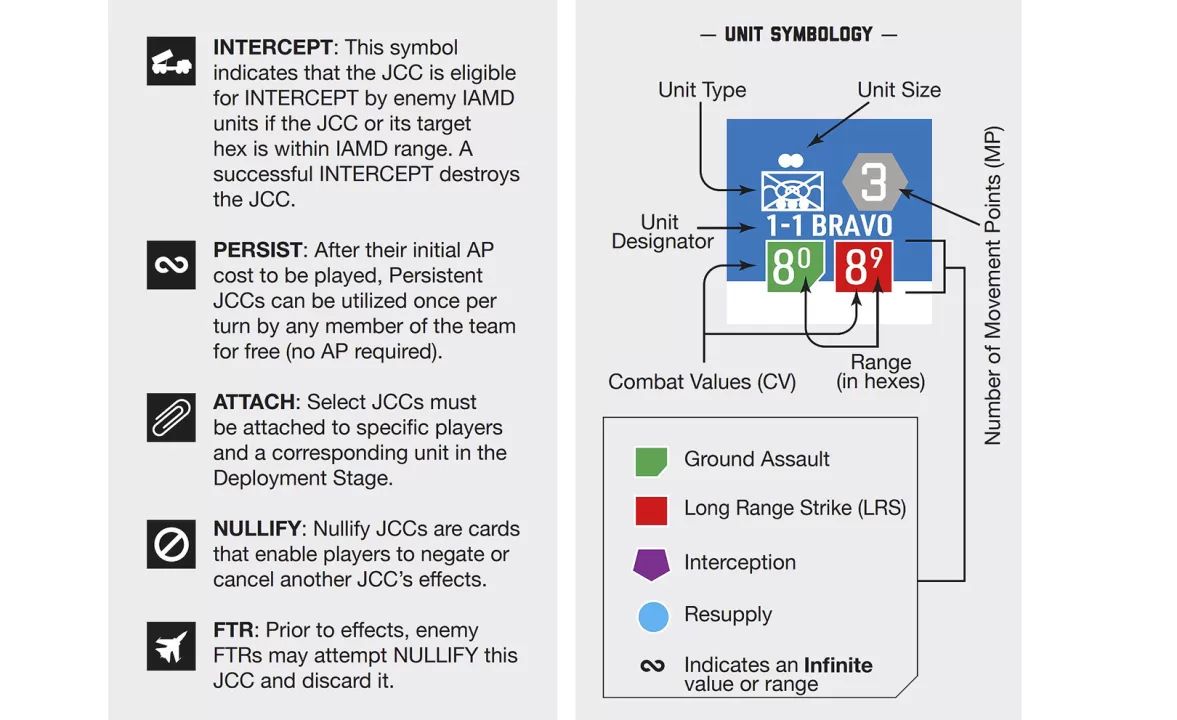
Counter layout is clear and easy to understand
After all Task Forces have been activated, Initiative is determined (usually by the number of enemy units eliminated), and Victory Conditions are checked. If these conditions have not been met, a new Turn is played till one side fulfills its Victory Conditions or till the last Turn of the Scenario.
Multi Domain Warfare
Multi Domain Operations (MDO) is the concept behind 21st-century combat. It’s a military strategy that synchronizes and integrates traditional combat assets with (previously) non-military activities like cis-lunar, cyberspace, and population control. As far as I know, LC is the only wargame that incorporates this. This is particularly evident in its use of the Joint Capability Cards (JCCs) that showcase the likes of cyberattacks, space warfare, and fake news on social media, to name a few. The game shows how these elements interact with ground, naval, and air forces.
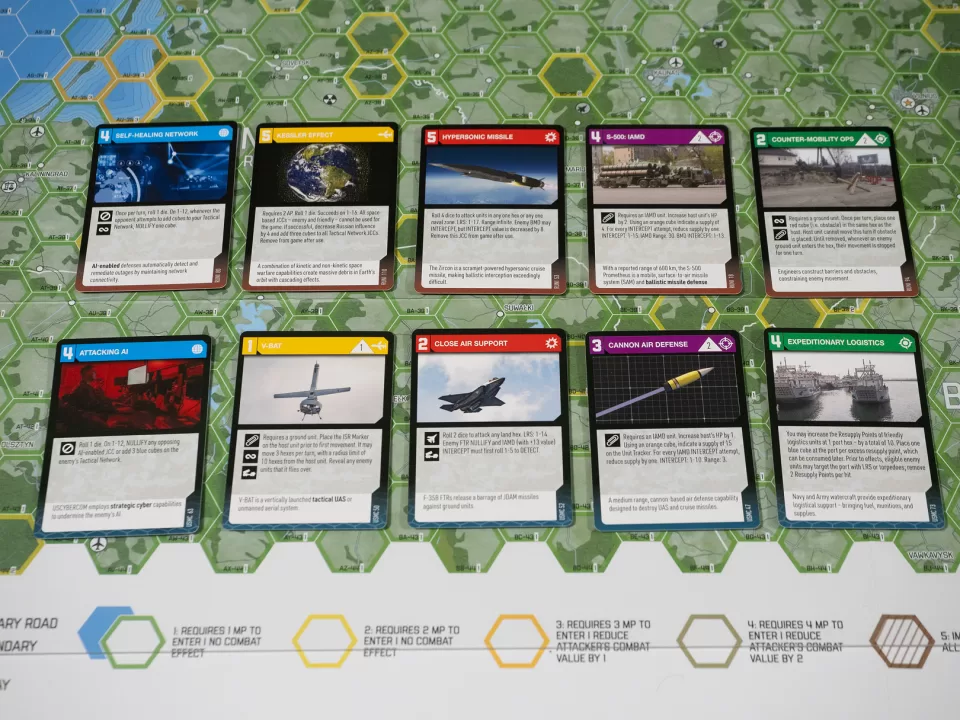
Joint Capability Cards emphasize the Multi-Domain concept.
Incorporating MDO into a game sounds complex. But it integrates beautifully with LC gameplay. All JCCs have text descriptions on how they work, and they are easy to understand and implement.
Call of Duty
The best design achievement of the Littoral Commander series is that, despite its grand scope, it is easy to learn and play – the hefty rulebook (full of examples) notwithstanding. The game plays relatively fast. It was purposely designed that way so that military officers spend more time developing strategies rather than understanding the rules. This makes the game highly playable for the casual wargamer and makes a good gateway wargame for anyone looking to dip into the hobby. I think anyone who has played some kind of combat game on a pc or mobile phone will be able to grok Littoral Commander. Another design highlight is that the game does away with clutter that can sometimes plague other wargames. There are relatively few counters in the game, and there are no charts or intricate steps to check. Despite its ease of play, it still contains a lot of technical detail that will also appeal to the more hardcore wargamer and provides an exciting and tense gaming experience where a myriad of strategies can be explored.
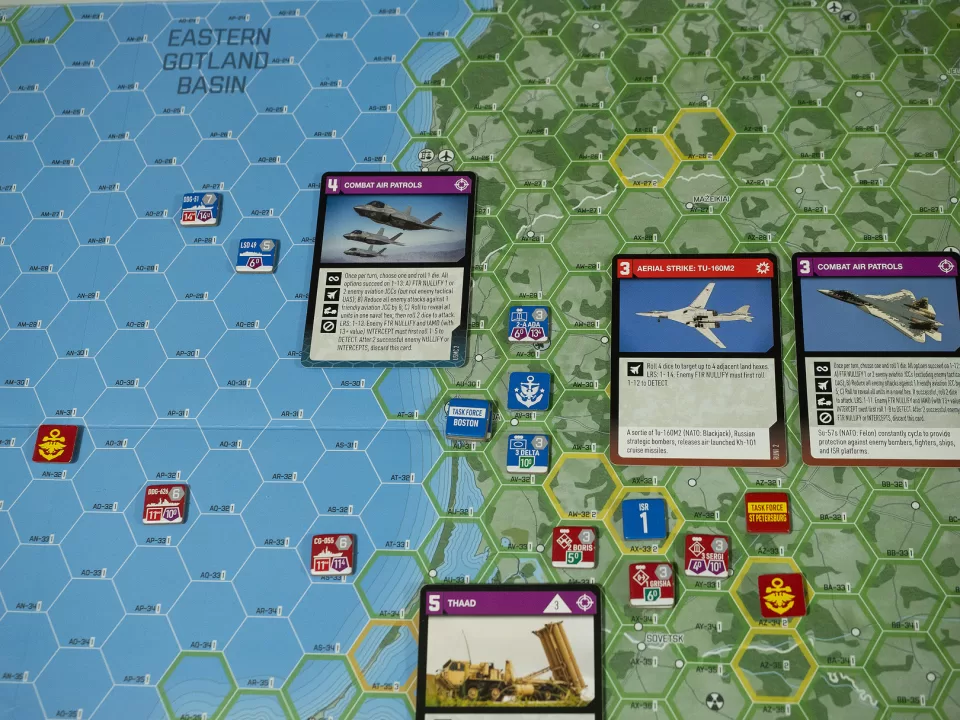
A game of LCB. Fast playing, intense, minimal counter clutter
A Clear and Present Danger
LC is a training component of the US Marines. Interestingly enough, the Philippine Marines and Navy also use Littoral Commander Indo Pacific as part of their force development. I have also introduced the game to the Philippine Air Force. It is exciting to see gaming making crossroads in military circles in our country. The Philippine Marines even held an LCIP tournament during their anniversary. I’ve always admired games that go beyond the realm of fun and entertainment. Does the game have flaws? I’m sure some will complain about the paper maps, simple dice roll resolutions, and a need for more granularity. But I can’t deny that the game might be integral in one of the most important aspects of our country – defending its sovereignty.
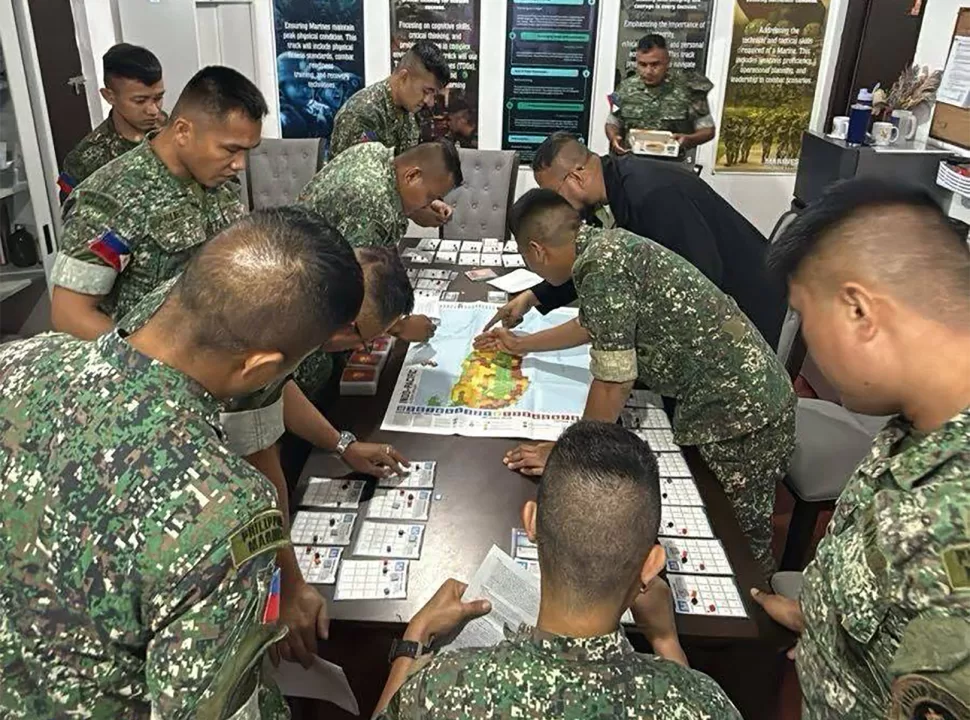
Philippine Marines playing Littoral Commander Indo Pacific